
Is CCIE Worth It in 2026? Cost, Salary, Prerequisites & Honest Verdict
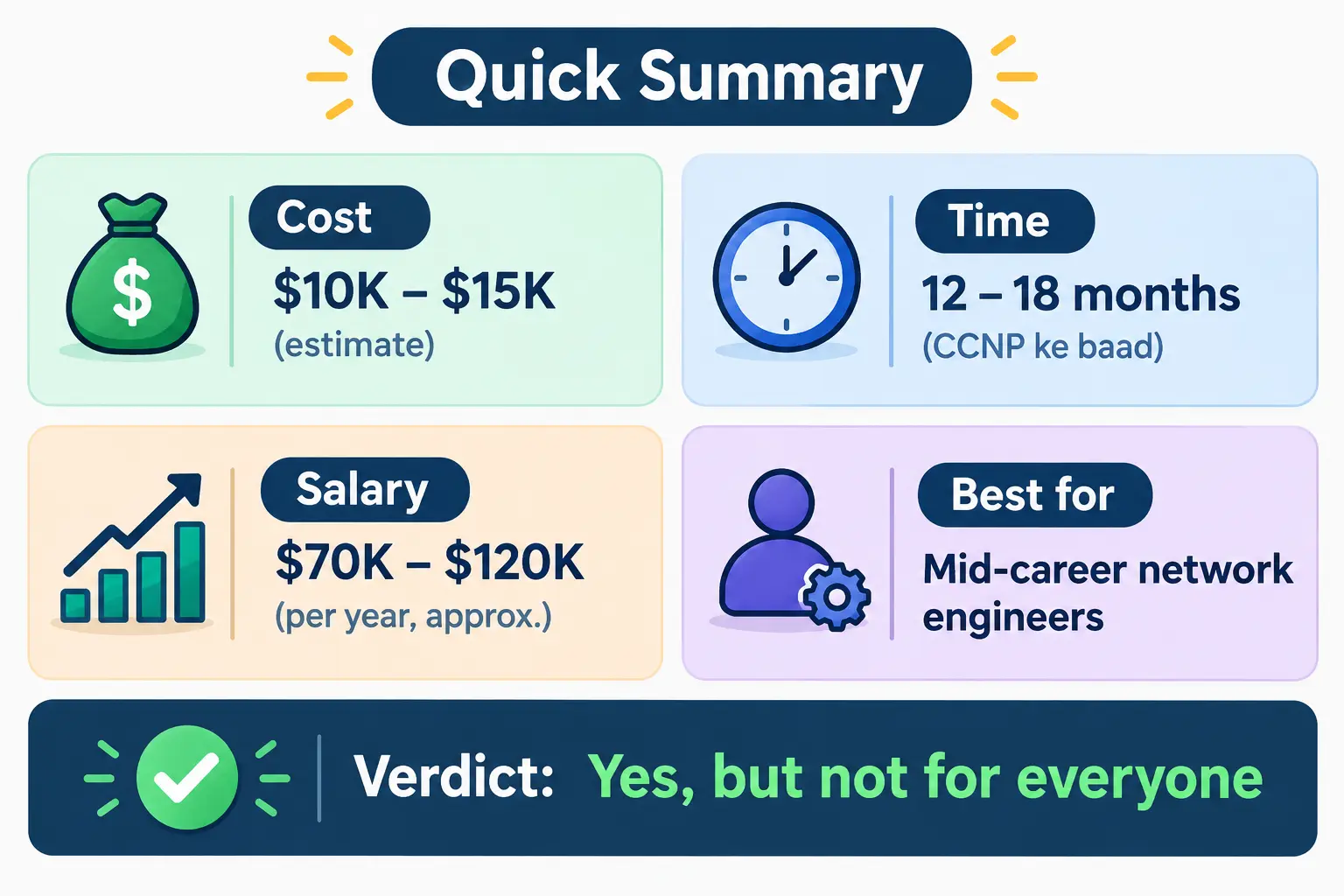
Is CCIE worth it? For a network engineer with a few years of hands-on experience who wants senior, architect or consulting roles, usually yes. For beginners or people moving fully to cloud, usually no.
Before You Start
Table of Contents
Is CCIE Worth It? The Quick Answer
Short answer: Yes, if you are a mid-career network engineer who wants a big step up. No, if you are new to networking or want to work only in cloud or software.
Think of CCIE like a marathon, not a 5K run. The medal is real and respected, but you need months of training, money and patience to finish. Many people start. Fewer finish.
Key takeaways:
- Cost: Roughly $10,000 to $19,000 in total, including training, practice labs and travel
- Time: Often 12 to 18 months of serious study after CCNP-level knowledge
- Pay: Reports often show a jump of 20% to 40% or more, but it is never guaranteed
- Best for: Engineers with several years of hands-on work who want senior roles
What Is CCIE? Tracks and Enterprise Infrastructure Overview
CCIE stands for Cisco Certified Internetwork Expert. It is Cisco’s top-level networking certification. Unlike many exams, it is hands-on. You do not just pick answers. You build and fix real networks under time pressure.
Imagine a driving test. A written test checks if you know the rules. A road test checks if you can actually drive. The CCIE lab is the road test.
CCIE Tracks
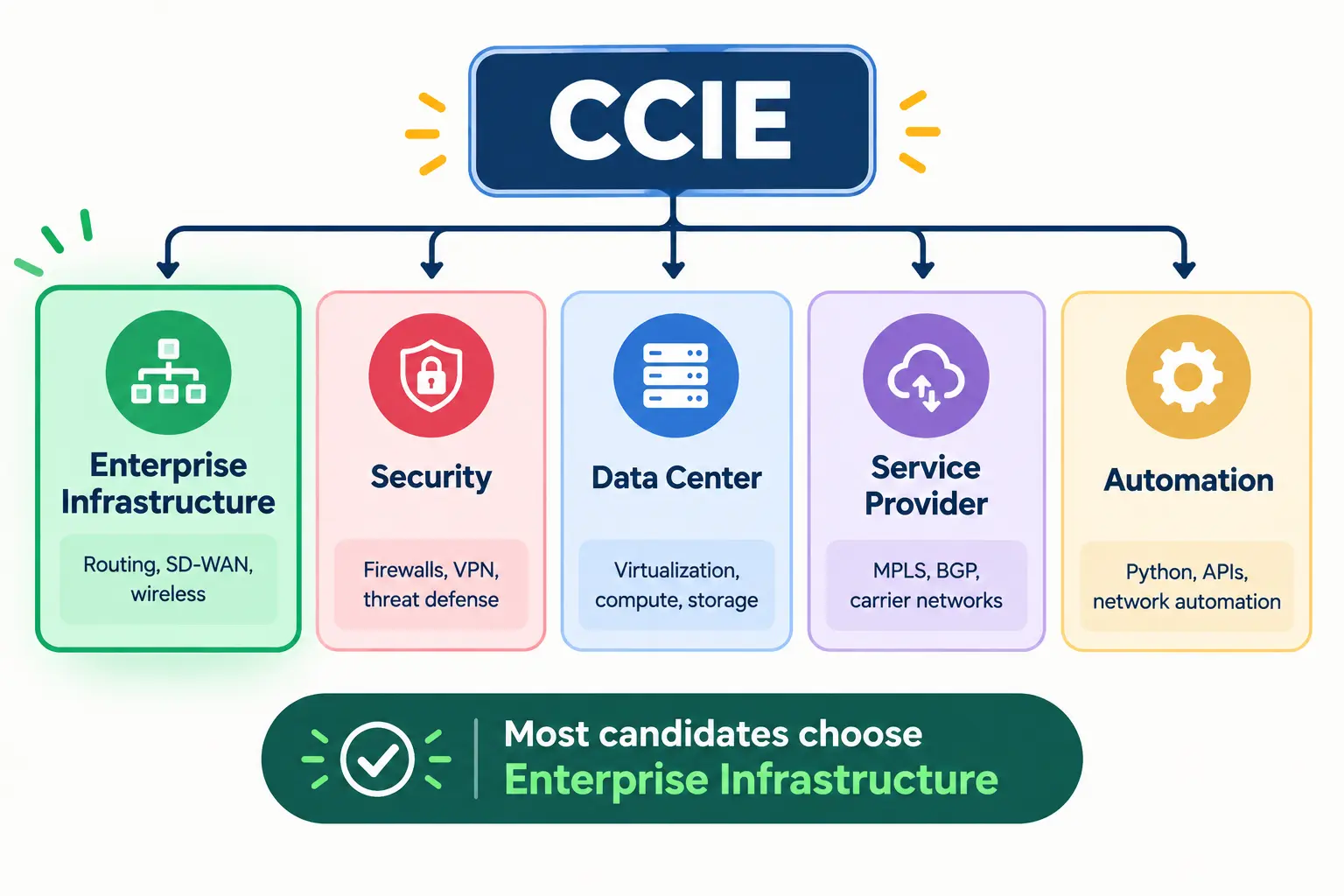
Cisco offers several tracks. Pick the one that matches your daily work.
| Track | Good for |
|---|---|
| Enterprise Infrastructure | Routing, switching, SD-WAN, office and campus networks |
| Security | Firewalls, VPNs, network protection |
| Data Center | Large server and cloud-style networks |
| Service Provider | Telecom and internet companies |
| Automation | Network programming and automation |
Cisco may change track names and offerings over time, so check Cisco’s certification page before you choose.
CCIE Enterprise Infrastructure: Exam Format and Topics
Enterprise Infrastructure is the most common starting point. You need to pass two exams:
- Qualifying exam (ENCOR 350-401): A written test on core enterprise networking
- Lab exam: An 8-hour hands-on test, split into a 3-hour Design module and a 5-hour Deploy, Operate and Optimize module
The topics include IPv4 and IPv6 routing, switching, SD-WAN, network security, wireless and automation. Cisco has also said a lab module that works with AI tools is being developed, so watch for updates.
CCIE Prerequisites: What You Actually Need
Cisco has no formal prerequisite. You do not need a certain degree or earlier certificate to book the exam. But “allowed” and “ready” are different things.
Is CCNP Required?
Not officially. In practice, almost everyone needs CCNP-level knowledge first. The good news: the ENCOR exam counts toward CCNP Enterprise as well as CCIE. So you can pass one exam and move toward both.
A simple example: skipping CCNP is like trying to learn calculus before algebra. You might manage, but it will be harder.
How Much Experience Do You Need?
There is no official minimum, but Cisco’s guidance points to several years of hands-on work (often quoted as 5 to 7). Ask yourself these questions. Have you:
- Set up routing between offices?
- Fixed a network outage under pressure?
- Worked with firewalls or SD-WAN in a real job?
If yes, you are in a good place. If everything you know comes from books, build more real experience first.
Qualifying Exam First, Then Lab
You must pass the qualifying exam before you can book the lab. Plan this as your first milestone.
CCIE Cost: Full Breakdown (Exams, Training, Retakes, Renewal)
Exam fees are only a small part of the bill. Training and lab practice cost more.
| Item | Typical cost (USD) |
|---|---|
| Qualifying exam (ENCOR) | $400 |
| Lab exam | $1,600 (about $1,900 at some mobile labs using Cisco’s equipment) |
| Lab retake | $1,600 each time |
| Practice lab rental | About $50 to $300 per month |
| Books and study material | Around $200 to $500 |
| Online or bootcamp training | About $500 to $5,000 |
| Travel and hotel per attempt | About $700 to $1,600 |
Exam fees: Cisco.com. Other figures: industry estimates. Prices can change, so confirm on Cisco’s site.
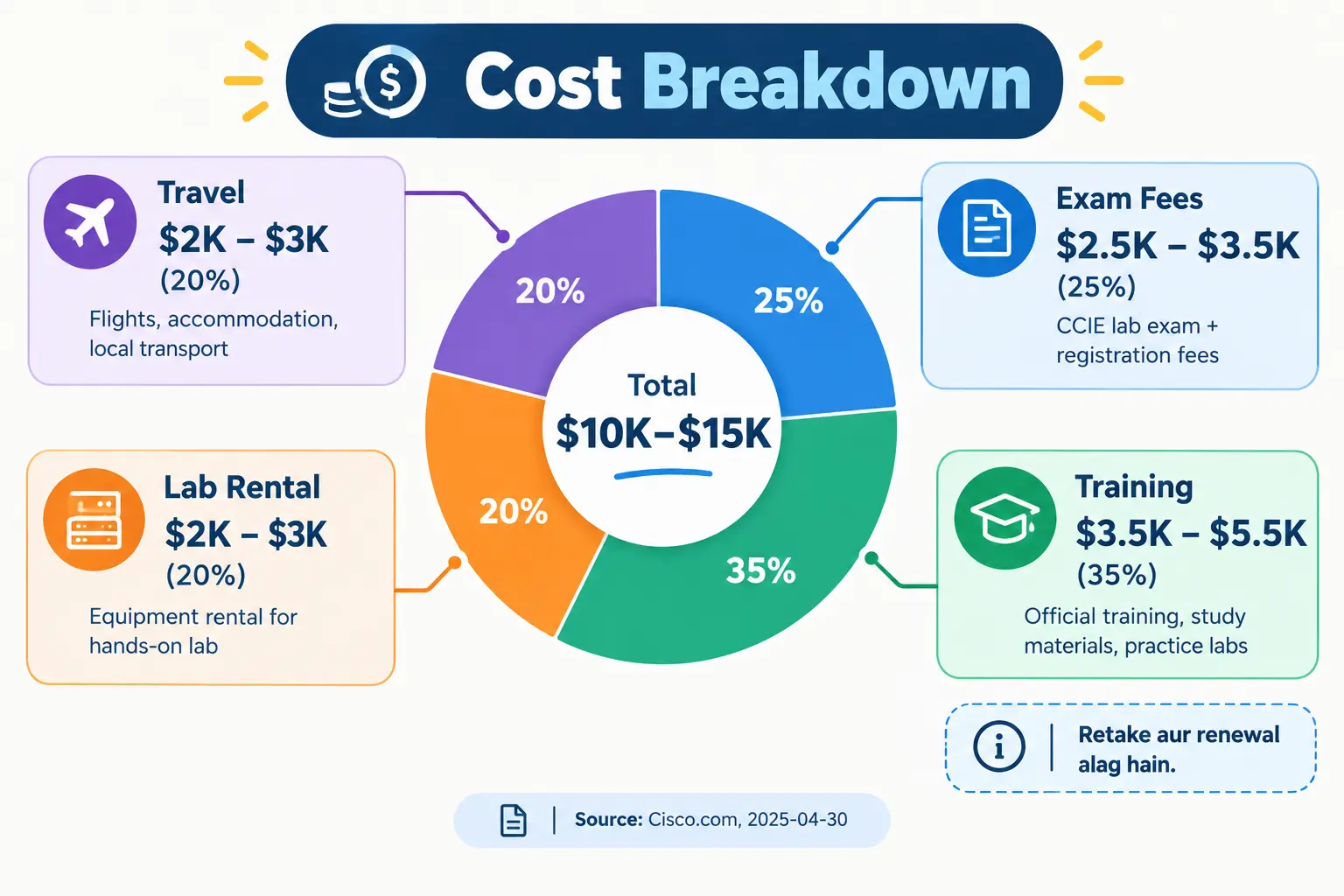
Real example: Sam pays $2,000 in exam fees, spends $4,000 on training, $1,500 on practice labs and $1,200 on travel. That is already $8,700, and he has not failed once yet.
What Happens If You Fail?
Many people do. You pay the full lab fee again, and Cisco has a waiting period before you can retry (commonly 30 days, so check the current policy). You may also pay for travel again.
Renewal Cost
CCIE is valid for 3 years. You renew by passing a qualifying exam or by earning continuing education credits through Cisco’s program. Budget for this, since most guides skip it.
Hidden cost: your time. Hundreds of evenings and weekends go into this. That is time you could have spent on family, rest or side income.
At this price, is CCIE worth it? For most experienced engineers, yes, as long as the pay jump follows.
How Long Does It Take to Get CCIE? (CCNA to CCIE)
The full path from zero often takes 3 to 5 years. Experience matters more than speed.
- CCNA: 3 to 6 months of study for most beginners
- CCNP: another 6 to 12 months, plus real job experience
- CCIE: often 12 to 18 months of focused preparation, or longer if you study part-time
Study hours are commonly reported between 800 and 1,500 hours. If you study 2 hours a day, that is about 1.5 to 2 years.
Is 3 years reasonable? Yes, if you already have CCNA and some job experience. It is tight if you are starting from zero.
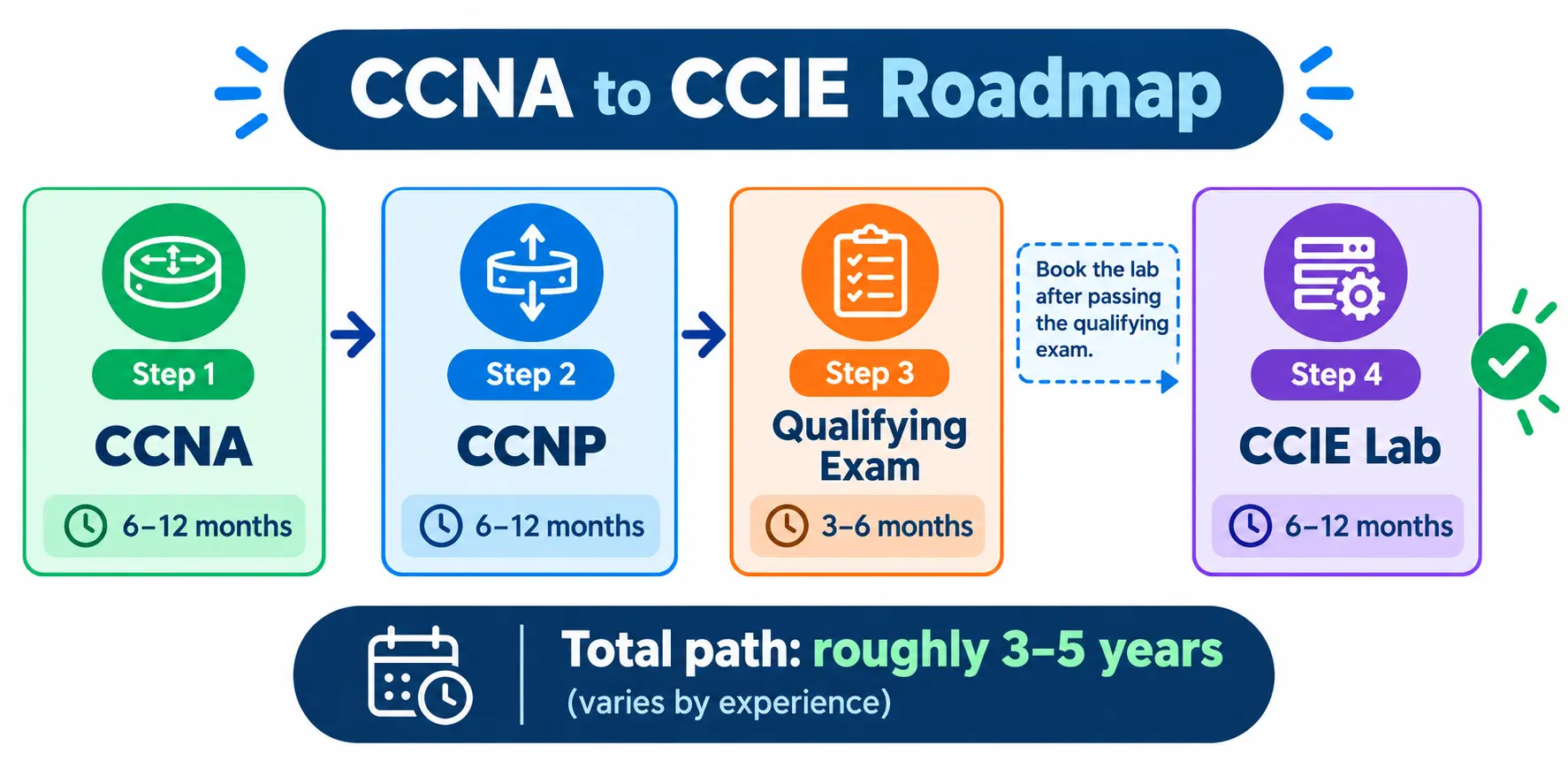
If this timeline feels long, it is worth asking again: “Is CCIE worth it for my goals right now?”
Tip: Start with the qualifying exam (ENCOR). It counts toward both CCNP and CCIE, so your effort is never wasted.
CCIE Salary and Job Market
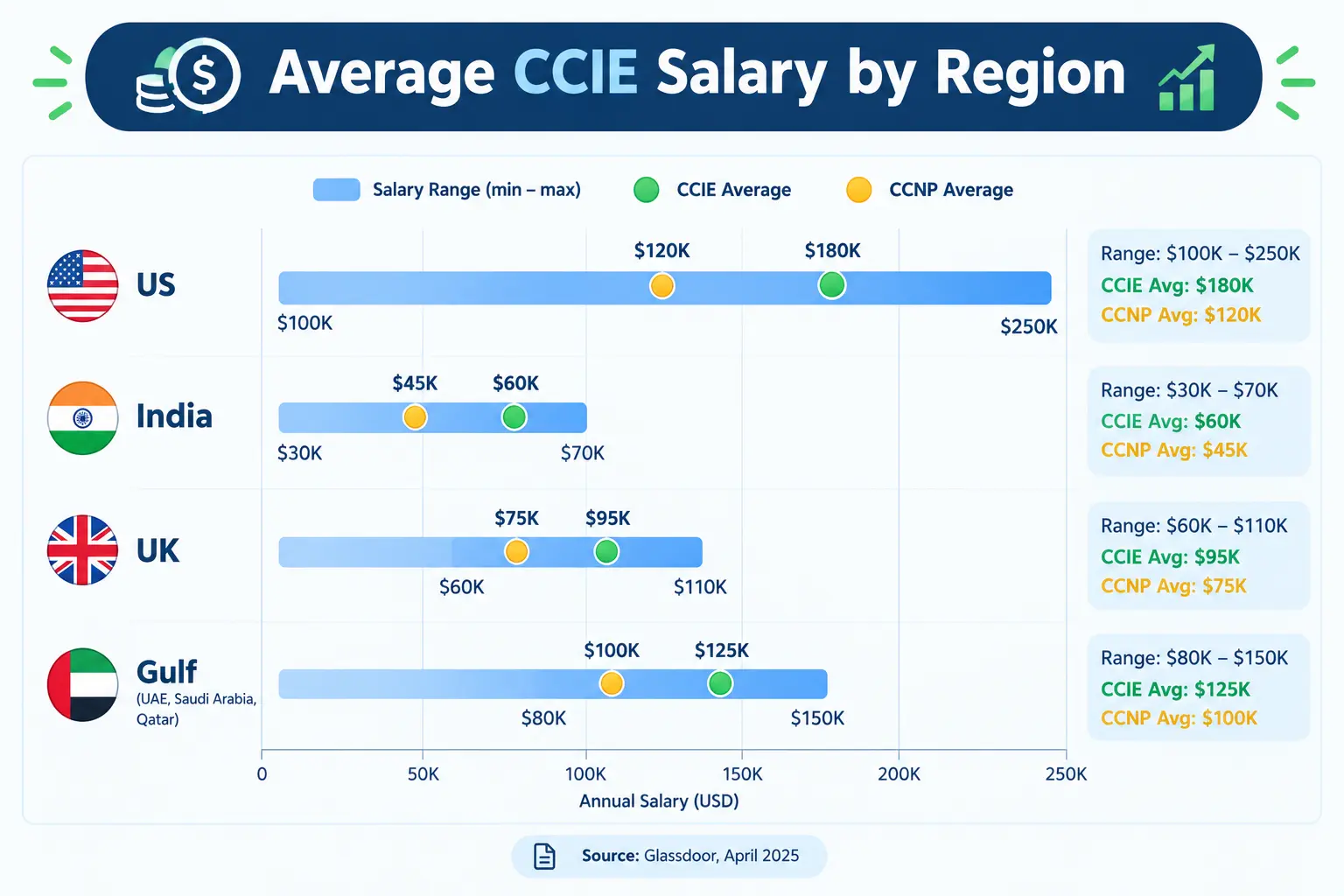
CCIE holders are usually paid well, but pay depends on country, role and company.
| Region | Reported range | Source |
|---|---|---|
| United States | About $130,000 to $180,000+ average, top roles above $200,000 | Glassdoor, ZipRecruiter, Talent.com (early 2026) |
| India | About ₹25 to ₹60 lakh per year for CCIE-level roles | Training provider placement data (treat the top end carefully) |
Salary websites use different methods. Job-posting data tends to be lower than self-reported data.
Salary by Track
Security and Data Center roles often pay more because companies struggle to find experts. Enterprise Infrastructure has more jobs and more competition.
Who Hires CCIEs?
You do not have to work at Cisco. Recruiters report demand from:
- Government and defense contractors
- Banks and financial companies
- Hospitals and healthcare networks
- Cisco partners and resellers
- Other vendors such as Palo Alto and Fortinet
Many managers do not know how to test network skills, so CCIE works like a shortcut. It tells them, “This person can run our network.”
Reality check: A CCIE does not guarantee a raise. A person with strong experience and no CCIE can still earn more than a CCIE with weak experience.
Pay is a big reason people ask, “Is CCIE worth it?” but it should not be the only reason.
Is CCIE Certification Worth It? Pros and Cons
Before you decide, here is what you gain and what you give up.
| Pros | Cons |
|---|---|
| Strong respect across the industry | Expensive in money and time |
| Often leads to higher pay and senior roles | Many people fail on early attempts |
| Proves real hands-on skill | Needs renewal every 3 years |
| Skills work across many vendors | Not needed for every job |
| Opens doors to consulting and architecture | Can cause burnout if rushed |
A word of caution: Online ROI claims such as “20x return” are usually too rosy. They only count people who passed. People who quit or failed are missing from the numbers. This is called survivorship bias.
How Hard Is CCIE? Pass Rate Explained
Cisco does not publish official pass rates. Community estimates vary a lot, from under 5% to around 25%, because nobody tracks the numbers the same way.
What we do know:
- The written exam is tough but doable with good study
- The 8-hour lab is the real challenge
- Time pressure causes many failures, not just missing knowledge
Example: Priya knows every routing protocol well. But in the lab she spends 40 minutes on one hard task and runs short on time later. She fails by a few points. Practicing full 8-hour mock labs would have fixed this.

When people ask, “Is CCIE worth it?” difficulty is half the answer. The other half is cost.
CCIE Training and Courses: Do You Need Them?
Training is not required, but most people find some structure helpful. Cisco says studying with its materials is recommended, not mandatory.
| Option | Cost | Best for |
|---|---|---|
| Self-study (books, free labs) | Lowest | Disciplined people with strong experience |
| Online video courses | Low to medium | Busy professionals who like flexible time |
| Live bootcamp or mentored course | Highest | People who need feedback and a deadline |
How to choose:
- Ask what you struggle with most: knowledge, time or discipline
- Check if the course includes real lab practice
- Read independent reviews, not just the provider’s own page
- Avoid anyone who promises you will pass
Who Should (and Shouldn’t) Pursue CCIE, Plus Alternatives
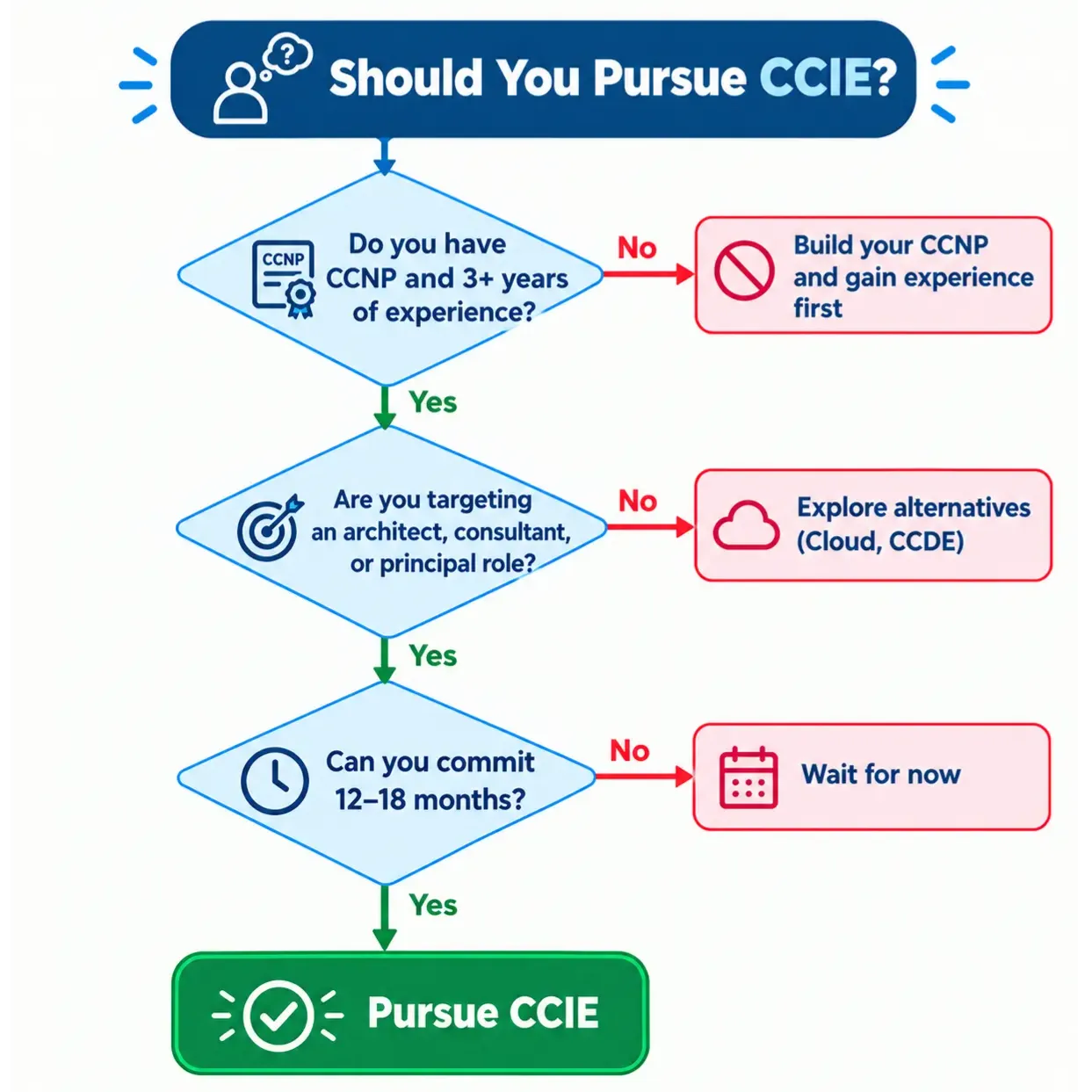
So, is CCIE worth it for you? It depends on three things: your experience, your goals and your free time.
Pursue CCIE If…
- You have CCNP-level knowledge and real job experience
- You want architect, consultant or principal roles
- You enjoy deep technical work
- You can give 12 to 18 months of steady effort
- Your employer may help pay
Skip CCIE If…
- You are new to networking
- You want to move fully into cloud or software
- You cannot afford the money or study time right now
- Your job pays the same with or without it
Alternatives to CCIE
- AWS or Azure certifications: better for cloud-focused careers
- CCDE: Cisco’s design-focused expert certification, good for architects
- CCNP plus automation skills: a cheaper path to strong pay
- Palo Alto or Fortinet certifications: useful for security-focused roles
- Juniper JNCIE: an expert path if your company uses Juniper
Is CCIE Still Relevant with AI, Automation and Cloud?
Yes, but the job is changing. Networks still exist behind every cloud service and every office. What is fading is someone who only types commands by hand.
- Learn basic Python or Ansible alongside CCIE
- Use AI for notes and config drafts, but check its work
- Keep your fundamentals strong, because when automation breaks, you must understand why
AI can draft a config. It cannot decide what a company’s network should look like. That judgment is where CCIEs earn their pay.
In the age of AI, is CCIE worth it? Yes, especially if you pair it with basic automation skills.
Frequently Asked Questions
Is CCIE still worth it in 2026?
Yes for experienced network engineers aiming at senior roles. It is less useful for beginners or people leaving networking for cloud-only careers.
How much does CCIE cost in total?
Cisco exams cost about $2,000 for one attempt. With training, labs and travel, most people spend roughly $10,000 to $19,000.
Is CCNP required before CCIE?
No, Cisco has no formal prerequisite. In practice, CCNP-level knowledge is expected, and the qualifying exam covers much of it.
How much experience is needed for the CCIE lab?
There is no official minimum. Cisco’s guidance points to several years of hands-on work, and many candidates have 5 or more.
How long does it take to go from CCNA to CCIE?
Often 3 to 5 years in total. The final CCIE stage usually takes 12 to 18 months of focused study.
Is CCIE training necessary?
No. Some people pass through self-study. Structured training helps if you need feedback, practice labs and a clear schedule.
What happens if you fail the CCIE lab?
You pay the lab fee again and wait before retrying. Many people need more than one attempt, so budget for it.
Which CCIE track is best?
Enterprise Infrastructure has the most jobs and study material. Security and Data Center often pay more. Choose what matches your work.
Final Verdict: Is CCIE Worth It?
CCIE is worth it when your career goals, experience and time all line up. It is a strong choice for mid-career engineers who want senior roles like architect, consultant or principal engineer. It is a poor choice if you are chasing a quick raise or a trend.
Here is a simple way to decide:
- Go for it if you have CCNP-level knowledge, real job experience and 12 to 18 months you can commit.
- Wait if you are still building experience. Start with CCNA and CCNP, and the CCIE will be easier later.
- Choose another path if your goal is cloud or software. AWS, Azure or automation skills may pay off faster.
Before you spend big, pass the qualifying exam first. It costs far less than the lab and shows you whether you are ready for the next step.