
CCNA Exam Prep: The Complete 200-301 Study Guide for 2026
Most people fail the CCNA not because it’s hard, but because they study the wrong things in the wrong order. This CCNA exam prep guide fixes that — you’ll get the exam breakdown, a realistic 12-week plan, the resources actually worth your money, and honest answers to the questions people ask before booking their test.
Before You Start
Table of Contents
What Is CCNA 200-301 and Why It Still Matters
CCNA is Cisco’s entry-level networking certification. Pass it and you’ve shown you can build, run, and troubleshoot a network that isn’t tiny.
People love to argue about whether certifications still mean anything. Fair question. But walk through any job board, filter for network roles, and CCNA keeps showing up in the requirements box. That’s the practical answer.
A few things worth knowing:
- Recruiters use it as a filter. No cert, and your CV often doesn’t get opened.
- The syllabus isn’t stuck in 2015. Automation, REST APIs, and AI in network operations are all in there now.
- It’s a foundation, not a ceiling. Cloud and security roles both assume you understand networking first.
If you’re coming from a support desk or finishing a degree, starting your CCNA exam prep now is usually the quickest route to being taken seriously.
CCNA v1.1 vs v2.0 — Which Version Should You Study?
Cisco is switching exam versions, and the one you prepare for depends entirely on when you sit the test.
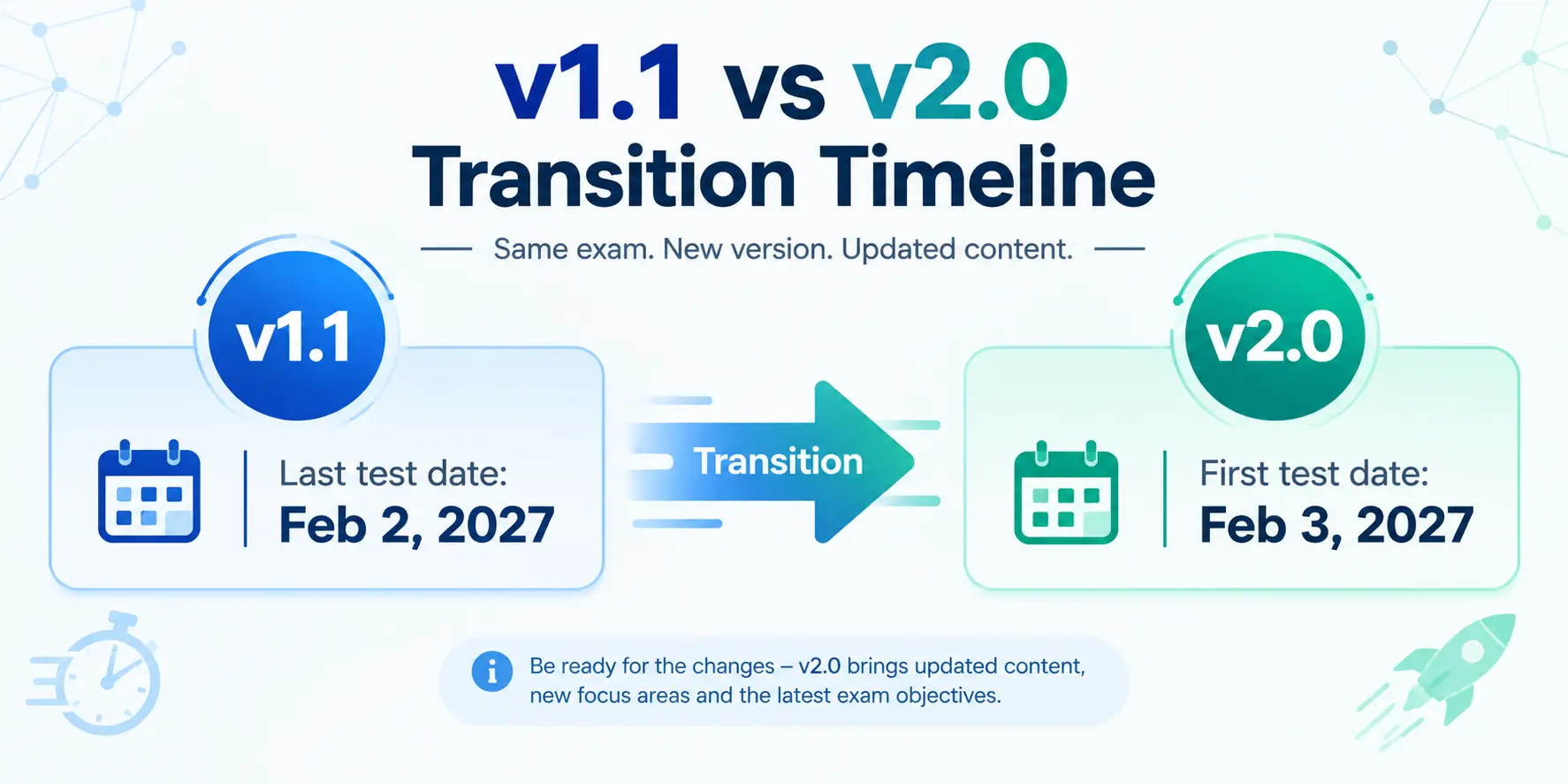
Key Transition Dates
- v1.1 — last test date is 2 February 2027
- v2.0 — first test date is 3 February 2027
Check these on Cisco’s official exam topics page before you book anything. Cisco has moved dates before.
What This Means for Your Study Plan
Testing before February 2027? Study v1.1 and stop worrying about it. Starting from zero right now and likely to test in 2027? Look at v2.0 topics before you spend money on books.
And if you’re already deep into v1.1 material — finish it, book early, sit the exam. Restarting because a new version is coming is how people lose six months.
Honestly, most content overlaps anyway. The changes tend to cluster in automation and security.
CCNA Exam Format, Domains and Passing Score
| Detail | Info |
| Exam code | 200-301 CCNA |
| Duration | 120 minutes |
| Questions | Roughly 100–120 |
| Passing score | Around 825/1000 |
| Cost | $300 USD |
| Languages | English, Japanese |
| Validity | 3 years |
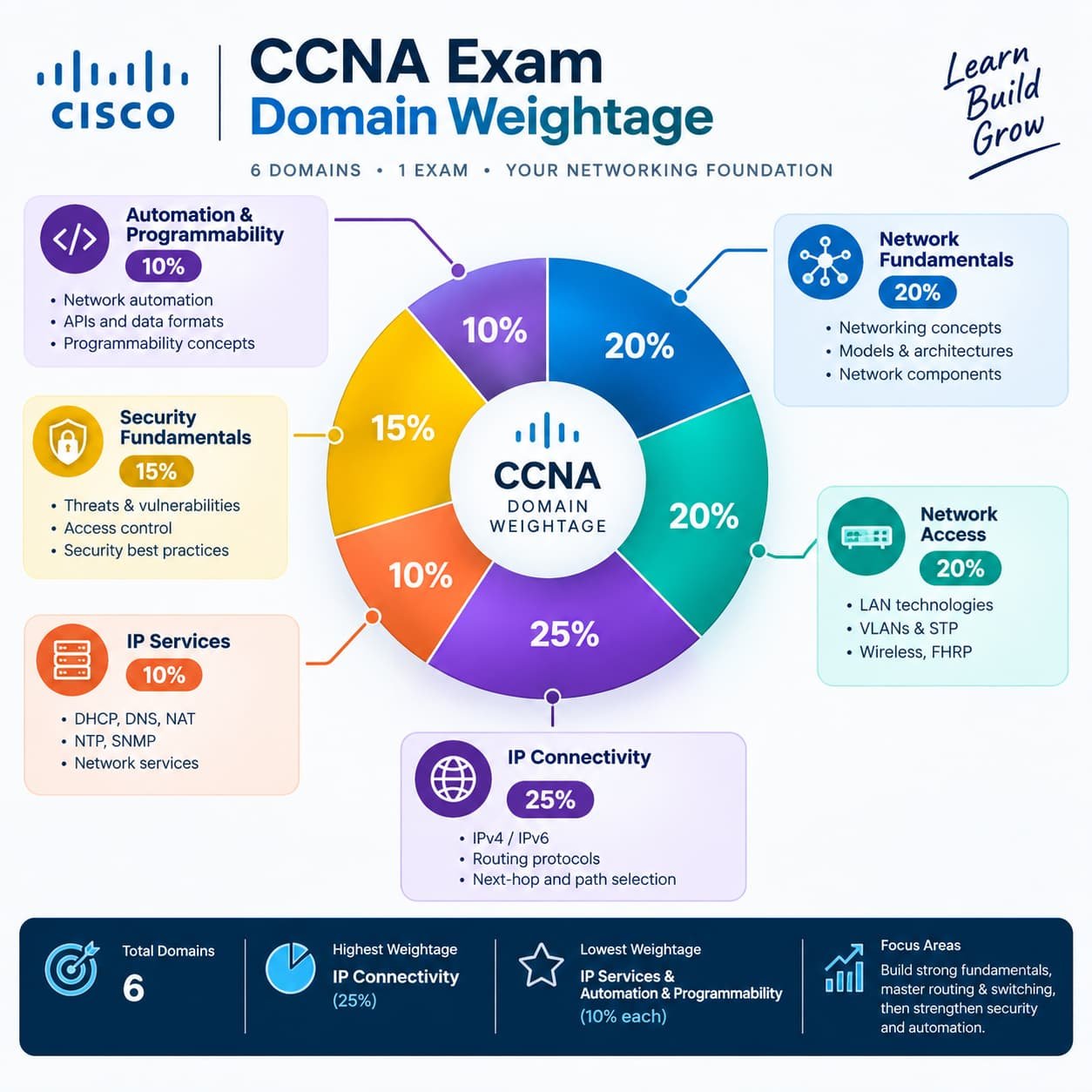
The Six Domains and Their Weight
| Domain | Weight |
| Network Fundamentals | 20% |
| Network Access | 20% |
| IP Connectivity | 25% |
| IP Services | 10% |
| Security Fundamentals | 15% |
| Automation and Programmability | 10% |
Look at IP Connectivity. A quarter of your entire score sits in one domain. If your time is limited, that’s where it goes.
Expect multiple choice, drag-and-drop, and simulations where you configure an actual device interface. The simulations are where time disappears fastest.
How Long Does It Take to Study for CCNA?
Most CCNA exam prep takes 8 to 16 weeks at 2–3 hours a day. Roughly 150–250 hours in total.
Timeline Based on Your Background
- Total beginner — give it 3 to 4 months. The first few weeks go entirely on addressing and subnetting before anything else clicks.
- Helpdesk or IT support background — 8 to 10 weeks is realistic. You know what a router does; now you learn to configure one.
- Already working in networking — 6 to 8 weeks, mostly filling gaps and drilling questions.
You’ll see people online claiming they passed in three weeks. Some did. Most already worked with Cisco gear daily. For everyone else, rushing usually means paying $300 twice.
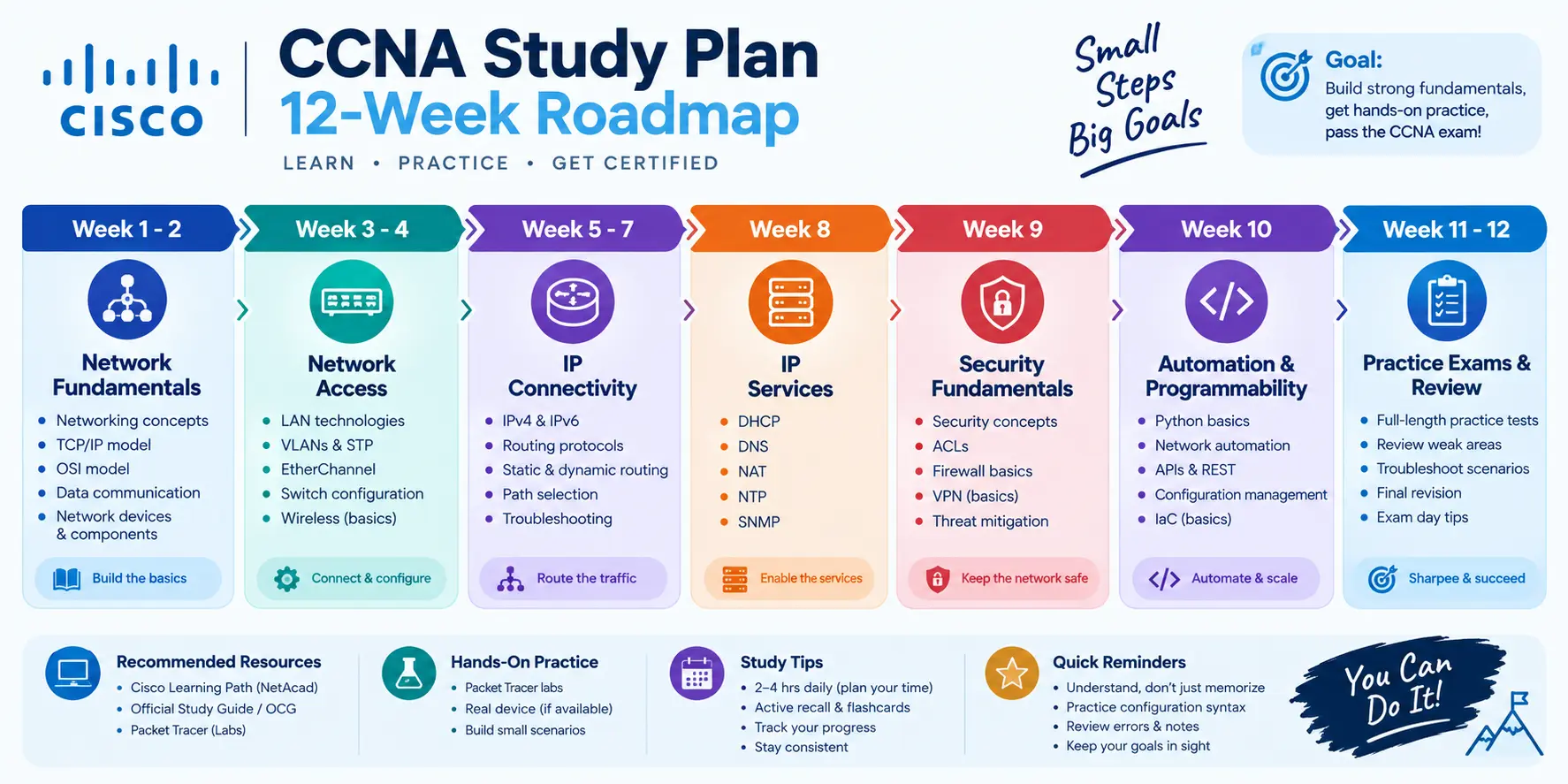
CCNA Study Plan: Week-by-Week Breakdown
This CCNA exam prep plan matches your hours to the domain weights, so you’re not spending three weeks on a 10% topic.
| Weeks | Focus | What to cover |
| 1–2 | Network Fundamentals | OSI model, TCP vs UDP, IPv4/IPv6 addressing, cabling |
| 3–4 | Network Access | VLANs, trunking, STP, EtherChannel, wireless basics |
| 5–7 | IP Connectivity | Static routing, OSPF, routing table, first-hop redundancy |
| 8 | IP Services | NAT, DHCP, DNS, NTP, SNMP, syslog, QoS |
| 9 | Security Fundamentals | ACLs, port security, DHCP snooping, WPA2/WPA3, AAA |
| 10 | Automation | REST APIs, JSON, controller-based networking, Ansible, Terraform |
| 11–12 | Review and practice | Full mock exams, drilling weak areas |
Habits That Make the Difference
Lab it the same day you learn it. Reading about VLANs and configuring one are completely different experiences. Packet Tracer is free — there’s no excuse.
Keep a mistake log. One page. One line per error. Read it every Sunday morning. This single habit catches more repeat mistakes than re-watching videos ever will.
Twenty questions a day beats two hundred on Saturday. Spaced repetition works; cramming doesn’t.
Explain things out loud. If you can’t describe how a router picks a route to a non-technical friend, you’ve memorised it rather than understood it.
Only have eight weeks? Squeeze weeks 1–2 and week 8. Leave weeks 5–7 alone.
Best CCNA Exam Prep Materials (Free vs Paid)
When it comes to CCNA exam prep, resource-hoarding is a real problem. People download fifteen PDFs and finish none of them. Pick one course, one book, one lab tool, one question bank. That’s it.
Free Resources
- Cisco Packet Tracer — Cisco’s own network simulator. Genuinely essential.
- Cisco Networking Academy / Skills for All — free official courses mapped to the real exam topics.
- Full YouTube courses — several creators cover the entire syllabus with labs, start to finish, at no cost.
- Cisco’s exam topics PDF — treat it as a checklist and tick things off. It keeps you honest about what you’ve actually covered.
Paid Resources
- Official Cert Guide books — the deepest coverage available. Great if you learn by reading.
- Video course subscriptions — better if watching beats reading for you.
- Practice exam platforms — most useful in the final three weeks, when you need pressure and timing.
- GNS3 or Cisco Modeling Labs — for people who want real device images instead of a simulator.
One rule that saves money: free material is enough to learn the syllabus. What you might want to pay for is a good practice exam engine, because that’s what tells you whether you’re actually ready.
Domain-by-Domain Preparation Tips
Good CCNA exam prep means giving each domain the attention its weight deserves — starting with the one that trips up beginners most.
Mastering Subnetting Fast
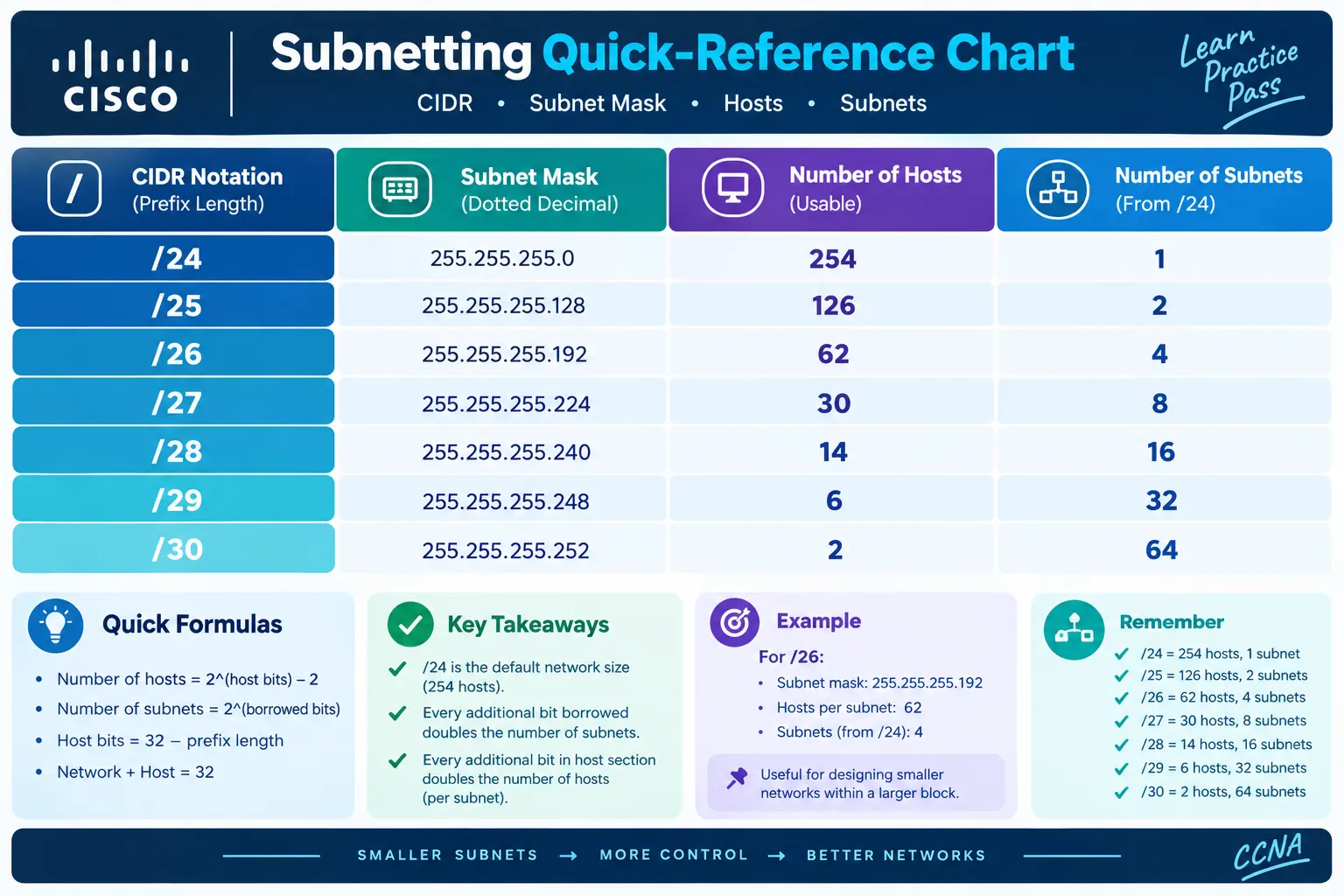
This is the topic that makes people quit in week two. It shouldn’t. It’s pattern recognition, not advanced maths.
Memorise the block sizes — 128, 64, 32, 16, 8, 4, 2. Then do ten questions a day, on paper, timed. By week three you should be under 30 seconds per question.
Here’s the mental model that helps: a /24 is a street with 254 houses on it. A /30 is a private driveway with space for exactly two cars. Once subnet sizes feel like physical spaces, the numbers stop being abstract.
Security Fundamentals — Where People Lose Marks
Fifteen percent of the exam, and consistently the domain people underprepare for. Concentrate on:
- ACL processing order — first match wins, and there’s an implicit deny sitting at the bottom
- Port security violation modes: protect, restrict, shutdown
- What separates WPA2 from WPA3
- AAA in plain terms — who are you, what can you do, what did you do
CCNA Automation and Programmability Explained
Ten percent, and the domain most people skip. That’s free marks handed away.
You don’t need to write Python. You need to read a JSON block and pick out keys and values, know what GET, POST, PUT and DELETE do, explain the split between control plane and data plane, and say in one sentence what Ansible and Terraform are for.
That’s genuinely it.
Should You Use CCNA Dumps?
Should dumps be part of your CCNA exam prep? No — and not just for ethical reasons — the practical case against them is strong enough on its own.
Cisco can revoke your certification and ban you from sitting future exams. That’s not theoretical; it has happened. Beyond that, dumps age badly, so you end up memorising answers to questions retired months ago. They’re useless for simulations, where you’re configuring a live interface rather than picking A, B, C or D.
Then there’s the interview. Someone asks you to walk through OSPF neighbour formation, and memorised answers fall apart in about eight seconds.
Use proper practice question banks instead. The value sits in the explanation, not the answer key.
CCNA vs DevNet Associate — Which Fits You?
| CCNA | DevNet Associate | |
| Focus | Network infrastructure | Programmability and APIs |
| Coding required | Barely any | Yes, Python basics |
| Suits | Network admin, support, security | Automation, DevOps, NetDevOps |
| Start here if | You’re new to IT | You already code |
For most freshers the answer is CCNA first. You can’t meaningfully automate a network you don’t understand yet. Add DevNet afterwards if automation turns out to be your thing.
CCNA Careers and Salary Outlook
CCNA commonly leads to roles like Network Administrator, Network Support Technician, Junior Network Engineer, Systems Administrator, or NOC Analyst.
Pay varies enormously by region. In the US, entry-level network roles often start somewhere around $45,000–$65,000, rising with experience. In South Asia and the Gulf, CCNA usually functions as a baseline hiring requirement rather than something that lifts your salary by itself.
Worth being clear: the certificate doesn’t get you hired. It gets your CV read. What happens next is on you.
Common CCNA Exam Mistakes to Avoid
- Studying theory without ever opening a lab
- Skipping automation because it feels unfamiliar
- Taking full mock exams in week two, scoring 35%, and losing motivation
- Rushing simulation questions, which carry serious weight
- Waiting to “feel ready” before booking — that feeling doesn’t arrive on its own
Frequently Asked Questions
How long does CCNA preparation take?
Usually 8–16 weeks at 2–3 hours daily, or about 150–250 hours total. Complete beginners should plan for three to four months.
Is CCNA still worth it in 2026?
For anyone entering networking, cybersecurity, or cloud infrastructure, yes. It’s still a standard requirement in job listings, and the current syllabus covers automation and AI in network operations rather than just legacy topics.
What is the best material to learn CCNA?
One structured course, one reference book, Packet Tracer for labs, and a practice question bank for the final weeks. Cisco’s free courses are a solid starting point.
Are CCNA dumps safe to use?
No. Cisco can revoke your certification and ban you from future exams, and dumps won’t prepare you for simulation questions anyway.
CCNA or DevNet Associate — which is better for a fresher?
CCNA first. DevNet assumes networking knowledge you won’t have yet.
What is the passing score for CCNA 200-301?
Roughly 825 out of 1000, though Cisco doesn’t publish a fixed official figure.
Should I wait for v2.0 or take v1.1 now?
If you can test before 2 February 2027, take v1.1. Waiting only makes sense if you’re starting from scratch and won’t be ready in time.
Conclusion
Pick your exam date first. Then work backwards twelve weeks and start with Network Fundamentals. A good CCNA exam prep routine isn’t complicated — it’s just consistent. A plan without a date is only a wish list.