
JNCIA vs CCNA:
Which Networking Certification Should You Choose First?
JNCIA vs CCNA is the first big choice for many networking beginners. This guide compares cost, difficulty, syllabus, jobs and study time so you can choose with confidence.
Before You Start
Table of Contents
Quick Answer: Which One Should You Pick?
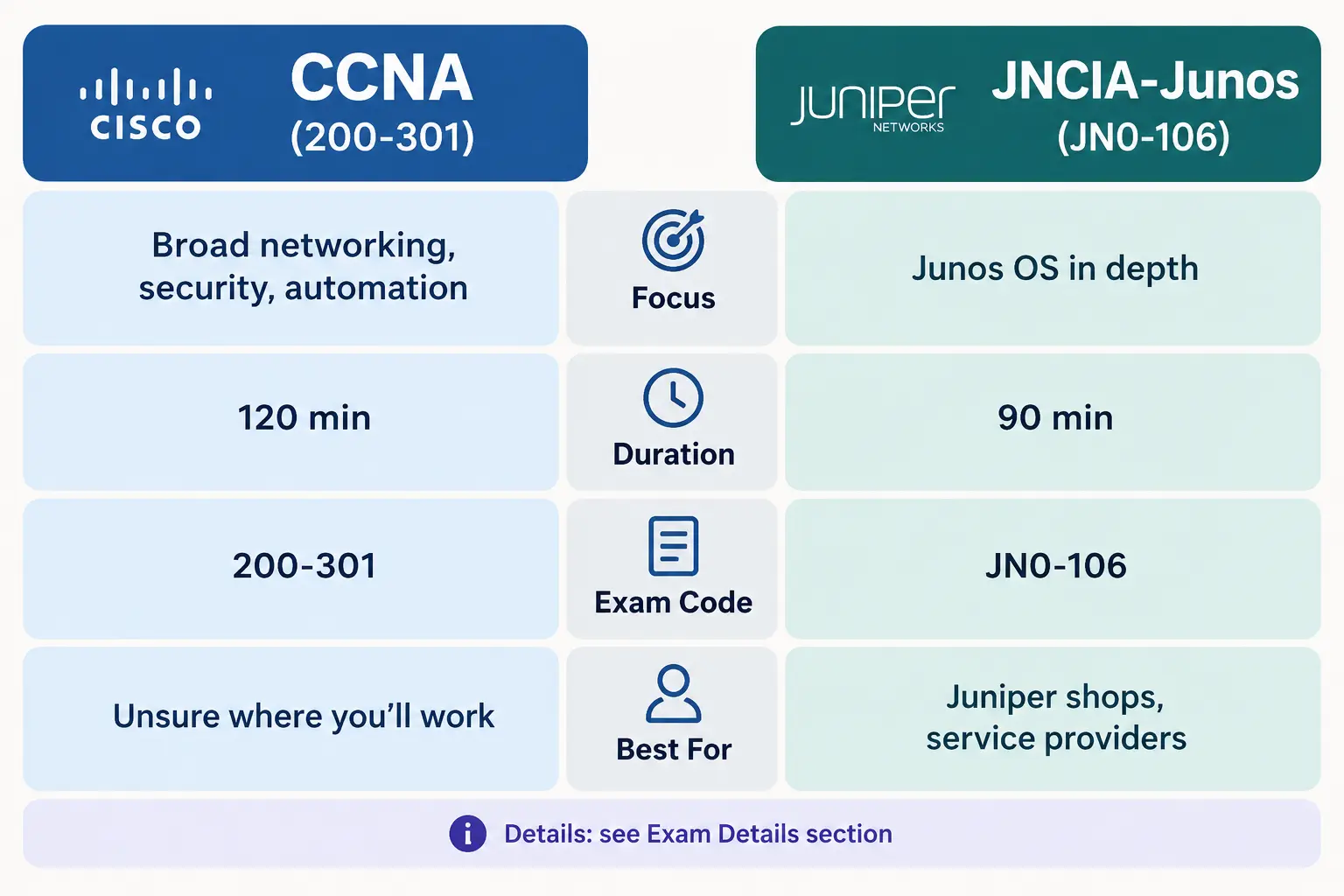
The JNCIA vs CCNA choice depends on where you will work. Pick CCNA if you are not sure. It covers more topics and is recognised by more employers. Pick JNCIA-Junos if you already know your job uses Juniper equipment. It goes deep on one system and is the starting point of Juniper’s certification path.
(The same logic applies if you search “CCNA vs JNCIA”: breadth first for the unsure, depth first for the sure.)
| Cisco CCNA | Juniper JNCIA-Junos | |
|---|---|---|
| Exam code | 200-301 | JN0-106 |
| Focus | Broad networking, security, automation | Junos OS in depth |
| Duration | 120 minutes | 90 minutes |
| Best for | Beginners who are unsure, students, help desk staff | People joining Juniper-based teams |
A simple way to think about it: CCNA is like learning to drive on many types of roads. JNCIA is like learning to drive one specific truck very well.
What Is CCNA?
CCNA stands for Cisco Certified Network Associate. It proves you understand the basics of how networks work and can set up common pieces like switches, routers and simple security. It is earned by passing one exam, 200-301, and it is valid for three years.
Typical people who take it:
- Students who want a first IT certificate
- Help desk staff moving to the network team
- Career changers applying to many kinds of companies
CCNA: Introduction to Networks vs the CCNA Exam
These are two different things, and many beginners mix them up.
- CCNA: Introduction to Networks is a course from Cisco Networking Academy. It is taught in schools and online.
- CCNA 200-301 is the certification exam you take at Pearson VUE.
Finishing the course does not make you CCNA certified. It only helps you prepare. Course certificate rules, including whether the Practice Final Exam is required, are set inside your Networking Academy class, so check with your instructor.
CCNA v1.1 vs v2.0: Check the Date
Cisco is updating the exam on a fixed date. The exam code stays 200-301, but the content changes.
- Last day to take v1.1: 2 February 2027
- First day to take v2.0: 3 February 2027
There is no overlap. If you can be ready before 2 February, study for v1.1. If not, study for v2.0 from the start. Studying one version and sitting the other wastes time. Confirm the dates on Cisco’s official CCNA page before you book.
What Is JNCIA-Junos?
JNCIA-Junos is Juniper’s entry-level certification. It proves you can use Junos, the operating system that runs Juniper routers, switches and firewalls. You earn it by passing the JN0-106 exam. Juniper also uses it as the first step toward its higher certifications, such as JNCIS.
Typical people who take it:
- New engineers joining an internet provider or data centre that uses Juniper
- Engineers who learned on another brand and are moving to Juniper
- Learners who prefer going deep on one system
JN0-102, JN0-105 and JN0-691: Old Exam Codes Explained
Older study material and forum posts mention several codes. Here is the simple version:
- JN0-106 is the current JNCIA-Junos exam. It started on 6 April 2026.
- JN0-105 was the previous version and was retired on 5 April 2026.
- JN0-102 is an even older version.
- If you see another code, such as JN0-691, check the exam name first. It may belong to a different certification.
Always buy books and practice tests made for JN0-106, or you may study outdated topics.
JNCIA vs CCNA Exam Details
The table below shows the main facts. Where a company does not publish a number, it says so instead of guessing.
| Detail | CCNA (200-301) | JNCIA-Junos (JN0-106) |
|---|---|---|
| Exam fee | US$300 | US$200 |
| Duration | 120 minutes | 90 minutes |
| Questions | Not officially published | 65 multiple-choice |
| Question style | Multiple choice, drag-and-drop, hands-on tasks | Multiple choice |
| Passing score | Not published | Not published |
| Delivered by | Pearson VUE | Pearson VUE |
| Language | English, Japanese | English |
| Valid for | 3 years | 3 years |
| Prerequisites | None | None |
Fees can change and vary by country, tax and currency. Check the vendor or Pearson VUE page when you book. You may see “passing score” numbers on forums. Treat them as guesses unless the vendor publishes them.
What Happens If You Fail?
You can try again, but you pay the full fee each time.
- CCNA: You normally wait 5 days before a retake. If you pass, you cannot retake the same exam for 180 days.
- JNCIA-Junos: Retake waiting times are set by Juniper and Pearson VUE. Check them before you book your first attempt.
Plan your first attempt with some spare time, especially if the CCNA v1.1 deadline is close.
Syllabus: What Each Exam Covers
In the JNCIA vs CCNA syllabus, both exams teach the same core ideas: IP addresses, subnetting, switching, routing and basic troubleshooting. The difference is width versus depth.
CCNA Exam Domains
These are the v1.1 domains and their official weights:
- IP Connectivity: 25%
- Network Fundamentals: 20%
- Network Access: 20%
- Security Fundamentals: 15%
- IP Services: 10%
- Automation and Programmability: 10%
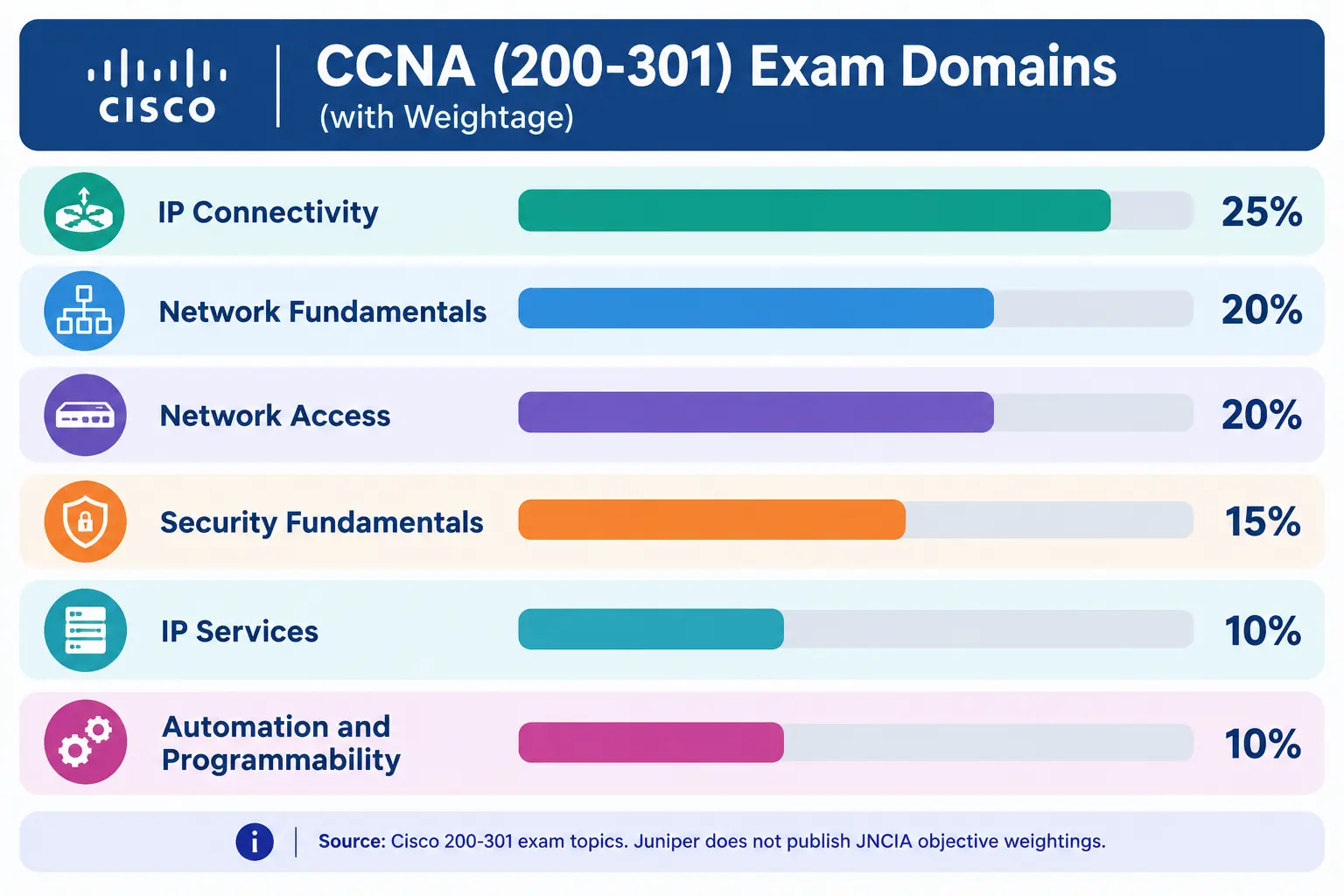
Cisco has announced a reorganised blueprint for v2.0, so check the current topic list if you plan to test after 3 February 2027.
JNCIA-Junos Exam Objectives
Juniper lists seven objectives and does not publish weights for them:
- Networking fundamentals
- Junos OS fundamentals
- User interfaces
- Configuration basics
- Operational monitoring and maintenance
- Routing fundamentals
- Routing policy and firewall filters
Only the first is general networking. The other six are about Junos itself.
CCNA Automation: Does JNCIA Cover It?
CCNA has a full domain on automation and programmability. It covers ideas such as how scripts and tools can configure many devices at once, and what APIs are. JNCIA-Junos has no separate automation objective, so if automation interests you, CCNA gives you an earlier start.
Example: Imagine changing a password on 200 switches. Typing it 200 times is slow. Automation lets one script do it in minutes. CCNA introduces this thinking.
JNCIA vs CCNA Difficulty
JNCIA-Junos is narrower, so many people prepare for it faster. CCNA is broader, so it usually takes longer. Narrower does not mean easy, though.
- CCNA is harder because of its width. You must know many topics, and some questions ask you to do tasks, not just pick answers.
- JNCIA is harder in a different way. Junos works differently from other systems. You edit a draft copy of the settings, then “commit” it to make it live. If you have never seen this, it feels strange at first.
Example: If you have only used Cisco-style commands, Junos feels like switching from Windows to Linux. Nothing is impossible, but it takes a few weeks to feel natural.
Your starting point matters most. If you already understand subnetting and routing tables, both exams become much easier.
Cost Breakdown: Exam Fee and Hidden Costs
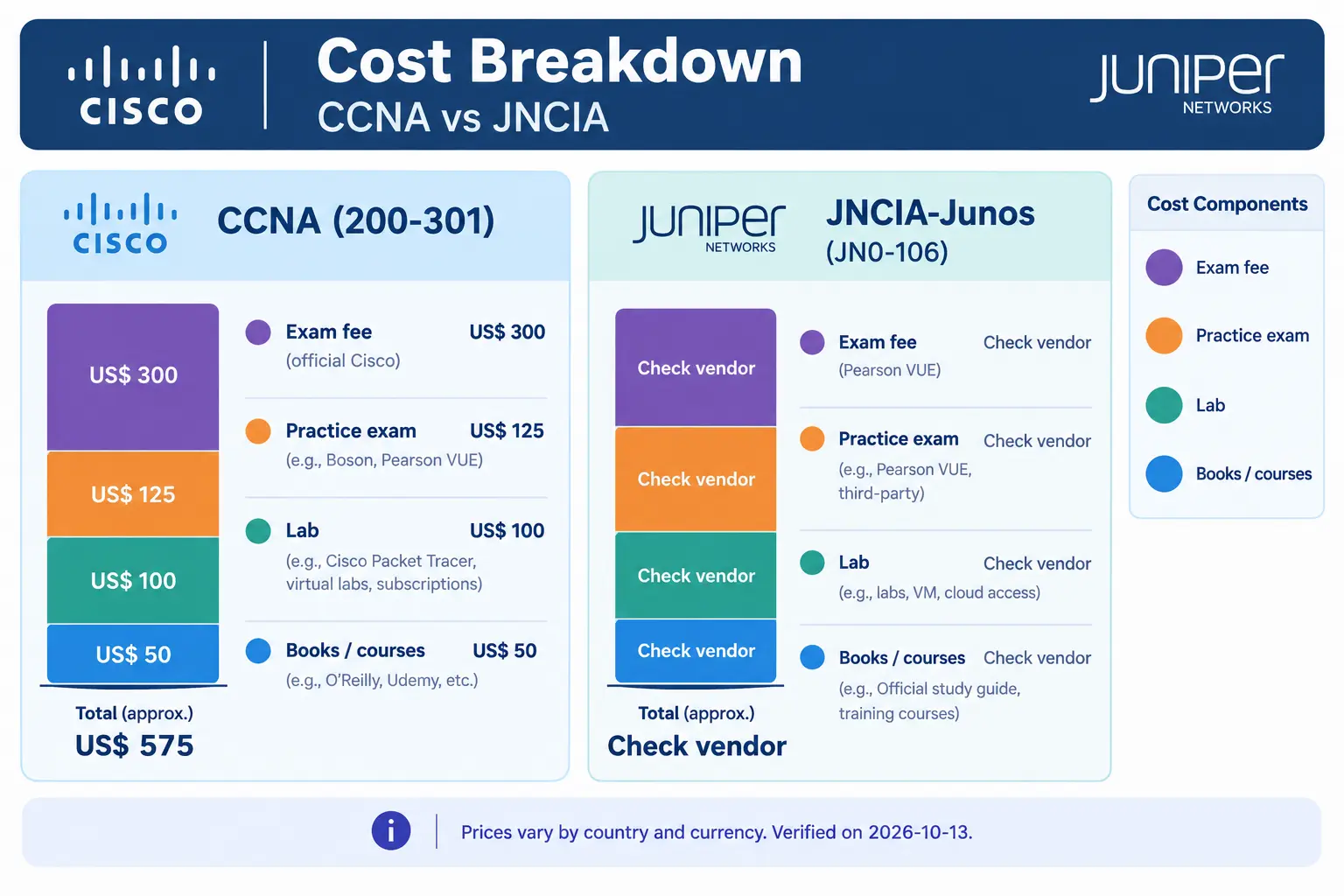
The exam fee is only part of the JNCIA vs CCNA cost. Exam fees are in the Exam Details table above, so here are the extras.
| Cost | CCNA | JNCIA-Junos |
|---|---|---|
| Study book or video course | Optional, often paid | Optional, some free material exists |
| Practice exams | Often paid | Often paid |
| Lab practice | Free tools available | Free tools available |
| Retake | Full exam fee again | Full exam fee again |
Free tools worth using:
- Cisco Packet Tracer: free through Cisco Networking Academy
- Cisco Modeling Labs: Cisco says you can start for free
- Juniper vLabs and free Juniper learning material: check Juniper’s site for what is available
A careful self-learner can keep the total cost close to the exam fee plus one book and a practice test. Paid classroom courses cost much more. Whatever you buy, avoid “exam dumps”. They are leaked questions, they break the exam rules and they can get you banned. They also do not teach you the skills a job needs.
Study Plan and Best Resources
Neither vendor publishes a recommended study time. The plans below are estimates for someone studying 8 to 10 hours a week who already knows basic IP addressing. Adjust them to your pace.

CCNA Study Plan
| Weeks | Focus |
|---|---|
| 1-3 | Network fundamentals, IP addressing, subnetting |
| 4-5 | Switching, VLANs, network access |
| 6-8 | Routing, IP connectivity |
| 9-10 | IP services, security basics |
| 11 | Automation and programmability |
| 12 | Practice exams, weak topics, final revision |
This works as simple CCNA exam prep. If you are targeting v1.1, count backwards from 2 February 2027.
JNCIA Study Plan
| Weeks | Focus |
|---|---|
| 1-2 | Networking basics and subnetting |
| 3 | Junos OS and the command line |
| 4-5 | Configuration and the commit model |
| 6 | Monitoring and maintenance |
| 7 | Routing, policies and firewall filters |
| 8 | Practice exams and revision |
How to Use a CCNA Practice Exam
A CCNA practice exam is a diagnostic tool, not a memory game.
- Take one early to find your weak topics.
- Read the explanation for every wrong answer.
- Go back to the lab and fix that topic.
- Take another one near the end to check your timing.
If you score well only because you remember the questions, you have learned nothing. The same advice works for JNCIA practice tests.
JNCIA vs CCNA Jobs and Salary
CCNA opens more doors at first because more companies use Cisco. JNCIA-Junos is valued most where Juniper is used. Neither certificate alone guarantees a job. Employers also look at hands-on practice and communication.
Entry-Level Jobs for Freshers
Both certifications can lead to roles such as:
- Network support engineer
- NOC (Network Operations Center) technician
- Junior network administrator
- IT support technician moving toward networking
Campus placements and job ads often say “CCNA or equivalent”. A JNCIA-Junos holder with good basics can sometimes apply under that wording, but CCNA is the name more recruiters know. For JNCIA jobs, look at internet providers, data centres and large companies that run Junos.
Quick test: Open 20 job ads in your city or country. Count how many mention Cisco, CCNA, Juniper or Junos. That count is better advice than any article.
Salary Expectations
Salary depends on country, city, company and experience, so any single number would mislead you. Check current figures for your own location on Glassdoor, PayScale or local job boards before you decide. As a general rule, the certificate helps you get interviews, and your skills and experience raise your pay later.
Next Certifications
- After CCNA: Cisco’s professional level, CCNP
- After JNCIA-Junos: Juniper’s JNCIS level, in its enterprise or service provider tracks
- After either: The first exam teaches ideas that carry across brands, so a second certificate is usually quicker to earn.
Which Should You Choose First?
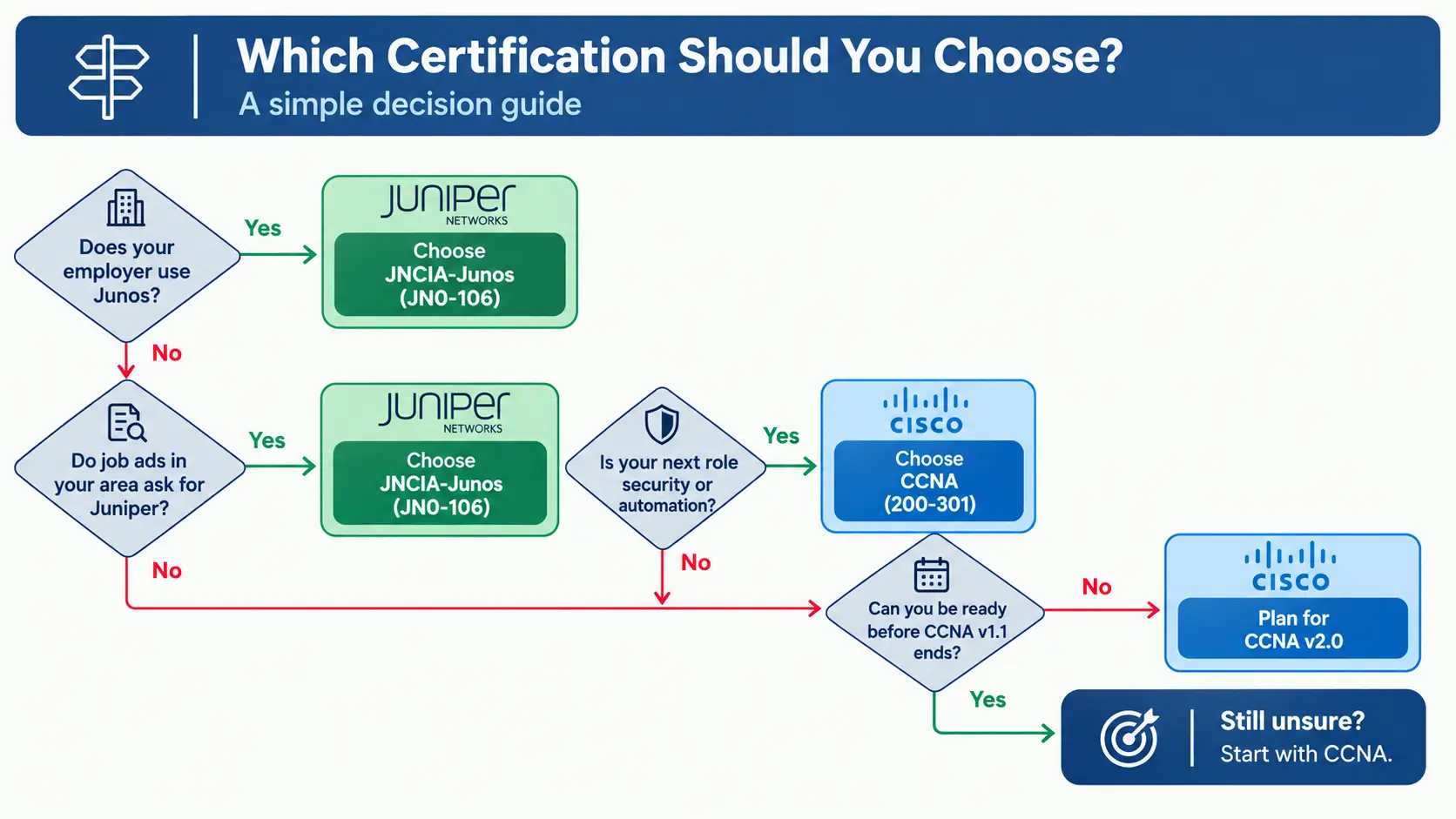
5-Step Decision Checklist
Use this checklist to settle the JNCIA vs CCNA decision. Go through the steps in order and stop when you get a clear answer.
- Does your employer or target employer use Juniper? If yes, take JNCIA-Junos. If they use Cisco, take CCNA.
- What do job ads in your area ask for? Follow the brand that appears most.
- What is your next role? Security or automation leans toward CCNA. Routing at an internet provider leans toward JNCIA.
- Can you be ready before 2 February 2027? If not, plan for CCNA v2.0.
- Still unsure? Start with CCNA. It keeps more options open.
Complete Beginner With No Networking Knowledge
Do not rush into either exam. Spend 2 to 4 weeks learning these first:
- What an IP address is
- The difference between a switch and a router
- Basic subnetting
- The OSI model in simple terms
Both exams assume you know these. After that, CCNA is the safer first choice because it teaches the basics more widely.
CCNA Burnout: Should You Switch to JNCIA?
It is fine to switch if the problem is the amount of material. Many people feel overwhelmed by CCNA’s width. JNCIA’s smaller scope can give you a quick win and restore confidence. Switch if:
- You are stuck and losing motivation
- You will also work with Juniper
- You plan to return to CCNA later
Do not switch only because you fear a hard topic. Subnetting and routing appear in both exams, so avoiding them just delays the problem.
Doing Both: Which Order Wastes Least?
- CCNA first: Its wide coverage teaches most of the basics, so JNCIA becomes mostly about learning Junos.
- JNCIA first: You build deep habits on one system, and CCNA later broadens your knowledge.
In both cases, take the second exam soon after the first while the shared topics are fresh.
Frequently Asked Questions
Is JNCIA better than CCNA?
Neither is better for everyone. CCNA is broader and more widely recognised. JNCIA-Junos is more focused and best for Juniper environments. Choose based on the equipment your employer uses.
Is JNCIA easier and faster to pass than CCNA
Often faster, because the scope is smaller. JNCIA has 65 questions in 90 minutes and focuses on one system. It is not automatically easier, since Junos has its own style.
Which certification should freshers take first?
Most freshers should start with CCNA because it keeps more job options open. Choose JNCIA first only if you are targeting a company or provider that uses Juniper.
Should I switch to JNCIA if I have CCNA burnout?
Yes, if the amount of material is wearing you down and Juniper is useful for your goals. Many people pass JNCIA first for confidence and return to CCNA later.
What is the total cost of JNCIA and CCNA, and what happens if you fail?
The exam fee is US$300 for CCNA and US$200 for JNCIA-Junos. Study material and practice tests are extra. If you fail, you pay the full fee again. CCNA has a 5-day wait before retaking.
6. Is JNCIA still worth it in 2026?
Yes, if you will work with Juniper or want a path into its higher certifications. Juniper released a new exam version, JN0-106, in April 2026. It is less useful if your local job market uses mostly Cisco.
Conclusion
There is no single best answer. CCNA gives a wide foundation and recognition across many employers. JNCIA-Junos gives focused skill on Junos and a clear path into Juniper’s higher certifications. Choose the one that matches the equipment you will actually use. If you cannot tell yet, start with CCNA, then add JNCIA when your job or interests point to Juniper.
Before you book, confirm the latest fees, dates and exam rules on the official Cisco, Juniper and Pearson VUE pages.