
CompTIA Security+ vs Network+: What to Choose Next (2026 Guide)
Not sure which one to pick in the CompTIA Security+ vs Network+ debate? Choose Network+ if you’re new to IT and want to learn how networks work. Choose Security+ if you already know networking basics and want a cybersecurity career. This guide compares difficulty, cost, passing score and jobs so you can decide with confidence.
Before You Start
Table of Contents
CompTIA Security+ vs Network+: Quick Answer
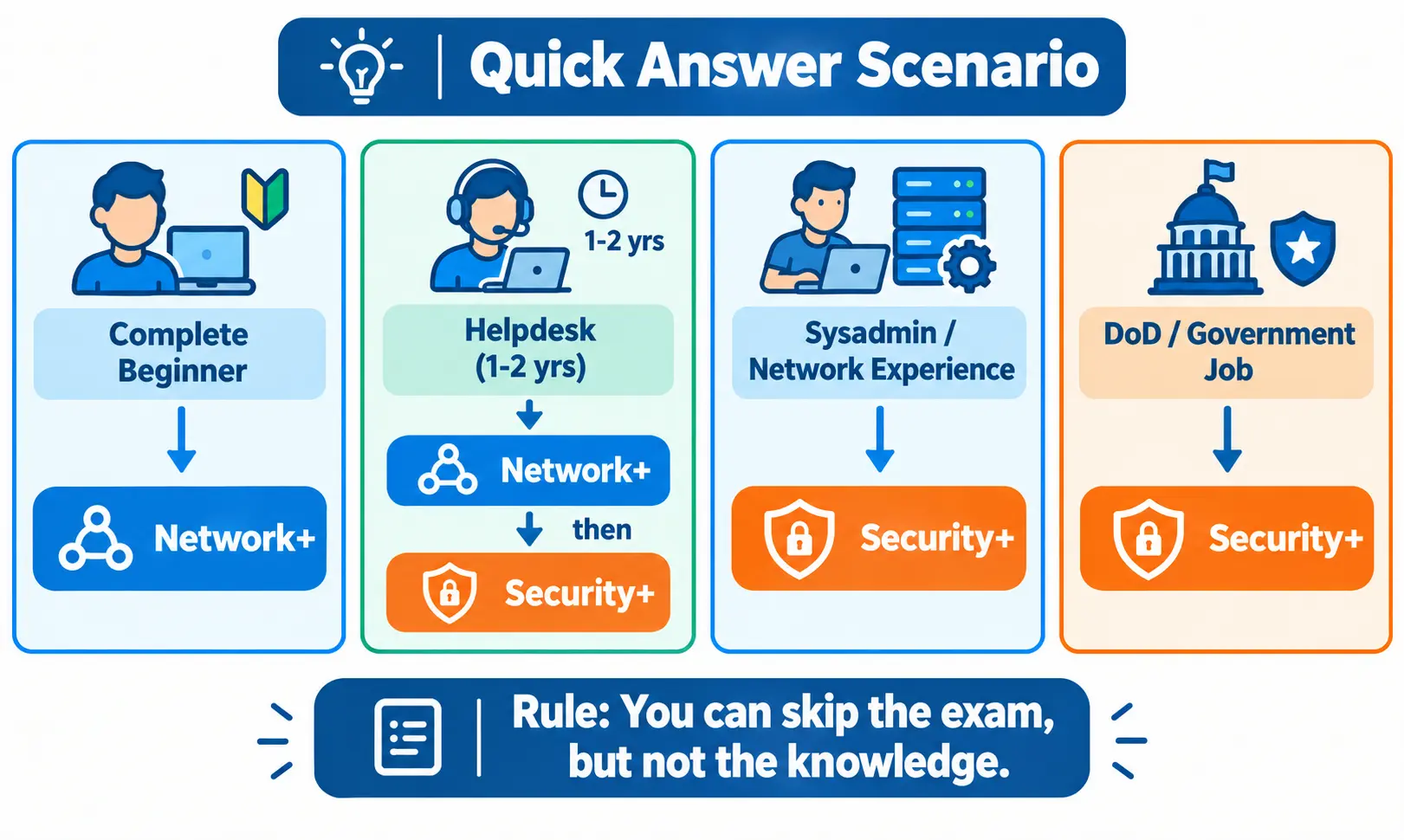
In the CompTIA Security+ vs Network+ choice, take Network+ first if you’re a beginner. Take Security+ first if you already understand networking and want to work in cybersecurity. Network+ teaches how networks are built and fixed. Security+ teaches how to protect systems from attacks.
Here’s the fast version:
- Complete beginner: Network+ (add A+ first if you’re new to computers in general)
- Help desk worker with 1 to 2 years of experience: Network+ first, then Security+
- Sysadmin or network technician: Security+
- Need a US government or defense contractor job: Security+
What Is Network+ Certification?
CompTIA Network+ is a vendor-neutral certification that proves you can set up, manage and troubleshoot networks. Vendor-neutral means it isn’t tied to one brand like Cisco or Juniper. The current exam is N10-009.
Think of a small office where the Wi-Fi keeps dropping. A Network+ trained person checks the router, looks at the IP settings, tests the cables and finds the problem step by step.
The exam has five domains:
- Networking Concepts: 23%
- Network Implementation: 20%
- Network Operations: 19%
- Network Security: 14%
- Network Troubleshooting: 24%
It suits people who want to work in IT support, network support or infrastructure. CompTIA recommends 9 to 12 months of hands-on experience, but it’s not required.
What Is Security+ Certification?
CompTIA Security+ is an entry-level cybersecurity certification. It shows you understand common threats and know how to reduce risk. The current exam is SY0-701. Many US government and defense jobs accept it under the DoD 8140 rules, though requirements differ from job to job.
Imagine an employee clicks a fake invoice email. A Security+ trained person knows what phishing is, how to isolate the computer, and how to add protections like multi-factor authentication so it’s less likely to happen again.
The exam has five domains:
- General Security Concepts: 12%
- Threats, Vulnerabilities and Mitigations: 22%
- Security Architecture: 18%
- Security Operations: 28%
- Security Program Management and Oversight: 20%

CompTIA recommends Network+ level knowledge plus about two years in IT administration with a security focus. Again, that’s advice, not a rule.
CompTIA Security+ vs Network+: Side-by-Side Comparison
| Feature | Network+ | Security+ |
|---|---|---|
| Main focus | Building and fixing networks | Protecting systems and data |
| Current exam | N10-009 | SY0-701 |
| Questions | Up to 90 | Up to 90 |
| Time | 90 minutes | 90 minutes |
| Passing score | 720 out of 900 | 750 out of 900 |
| Typical price (list) | About $369 | About $425 |
| Recommended experience | 9 to 12 months in networking | 2 years in IT admin (security focus) |
| Valid for | 3 years | 3 years |
| Renewal | 30 CEUs | 50 CEUs |
Prices change by country and seller. Check CompTIA’s store before you buy.

Network+ vs Security+ Difficulty
Most people find Security+ a bit harder in the CompTIA Security+ vs Network+ comparison, but it depends on your background.
- Network+ feels harder if you’ve never touched networking. You’ll deal with subnetting, port numbers, cables and commands. It’s a lot of facts, and some of it needs practice, not just reading.
- Security+ feels harder if you don’t like abstract ideas. It covers risk, policies, encryption and attack types, and many questions are scenarios where two answers look right.
A simple way to see it: Network+ asks “can you fix this?” Security+ asks “what’s the best way to handle this risk?”
Here’s a real example. A cloud engineer who works with DNS and firewalls daily may pass Network+ with little effort. A person from a retail background might find the same exam tough, but find security topics like phishing and passwords easy to relate to.
Both exams include performance-based questions (PBQs). These are mini tasks, like matching devices on a diagram or choosing the right security control for a scenario.
Network+ Passing Score and Exam Format
The passing score is 720 out of 900 for Network+ and 750 out of 900 for Security+. Both use a scaled score from 100 to 900.
Scaled means CompTIA adjusts scores to account for how hard each version of the exam is. So you can’t convert 720 into an exact percentage. As a rough rule, many learners aim for 80 to 85 percent on good practice tests before booking the real thing.
Exam format for both:
- Up to 90 questions
- 90 minutes
- Multiple-choice questions plus PBQs
- Taken at a Pearson VUE test center or online with a proctor
PBQs usually show up first. If one looks long, flag it and come back later so you don’t lose time.
If you fail, you can retake the exam, but you need to buy another voucher unless you bought a bundle with a retake. CompTIA can set waiting periods after repeated attempts, so read their retake policy before you plan.
Network+ Certification Cost vs Security+ Certification Cost
When you compare CompTIA Security+ vs Network+ cost, the exam voucher is the main expense. At list price it’s roughly $369 for Network+ and $425 for Security+. Prices differ by country, tax and reseller, so always check CompTIA’s store first.
Other costs to plan for:
- Retake bundle: Roughly double the voucher price, but it’s cheaper than buying a second voucher later.
- Study material: From free to a few hundred dollars. Video courses, books and practice tests are the usual picks.
- Renewal: Network+ needs 30 CEUs and Security+ needs 50 CEUs every three years. Continuing education courses cost extra, but a higher CompTIA cert can renew the lower one.
Ways to pay less:
- Ask about student or academic discounts.
- Check if your employer pays for certifications. Many do.
- Use free resources first: official exam objectives, free video courses and library books.
- Buy practice tests only when you’re close to ready.
Example: Sara buys a Security+ voucher and fails by a small margin. If she had bought a bundle with a retake, her second try would’ve been included.
Security+ Prerequisites (and Network+ Requirements)
There are no formal prerequisites for either exam. You don’t need a degree, and you don’t need A+ or Network+ before Security+. CompTIA only gives recommendations, which are in the table above.
Still, Security+ assumes you understand networking. Use this checklist before you start it:
- I can explain what DNS and DHCP do.
- I know the difference between a router, a switch and a firewall.
- I understand basic IP addresses and ports.
- I can explain what a VPN does.
- I know how to follow a simple troubleshooting process.
If you ticked fewer than three, start with Network+ or study the basics first. You can skip the Network+ exam, but you shouldn’t skip Network+ knowledge.
Network+ Jobs and Security+ Jobs
Neither cert guarantees a job. In the CompTIA Security+ vs Network+ job market, both can get your resume noticed.
Network+ Jobs
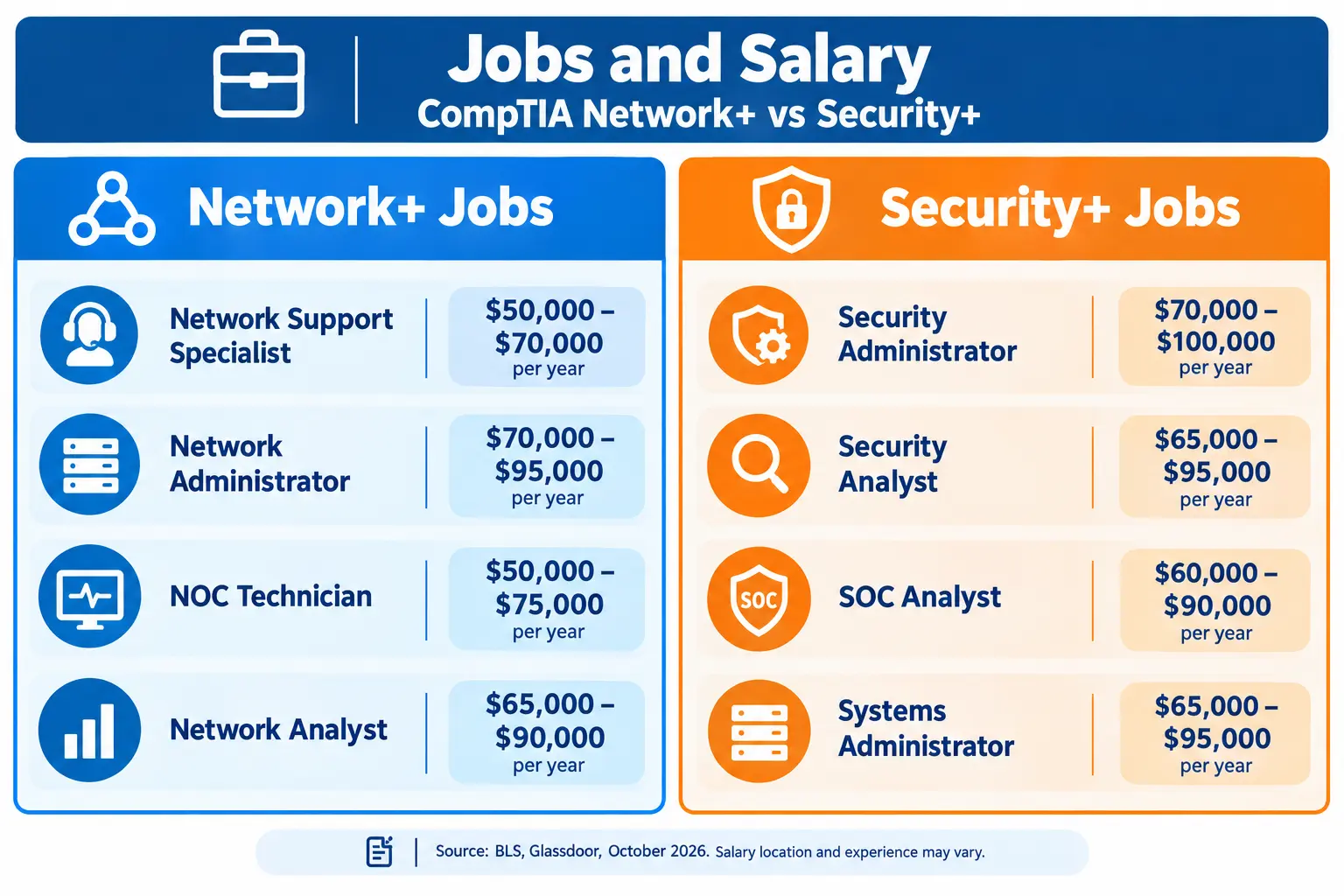
- Help desk technician
- Network support specialist
- NOC (network operations center) technician
- Junior network administrator
- Field service technician
The US Bureau of Labor Statistics (BLS) reports a median pay of $96,800 per year for network and computer systems administrators (May 2024). BLS also projects a 4 percent decline in that role from 2024 to 2034, so it helps to learn cloud and automation skills too. Entry-level roles like help desk pay less than that median.
Security+ Jobs
- Security administrator
- Junior security analyst
- SOC (security operations center) analyst
- Systems administrator with security duties
- IT auditor (junior)
BLS lists a median of $124,910 for information security analysts (May 2024), and expects much faster than average growth for the field. Remember, that’s a median for all experience levels. Most Security+ holders start in lower roles and work up.
Why Certification Alone Isn’t Enough
Many people on Reddit ask why they can’t get a job with only one cert. The reason is simple: employers want proof you can do the work.
- Build a home lab with a router, a few virtual machines and a firewall.
- Start in help desk or IT support and move up.
- Write down what you build and put it on your resume or LinkedIn.
- Apply for roles that match your level, not only “security analyst”.
Think of the cert as the key to the interview room. Your skills and projects decide what happens inside.
Which Should You Take First: CompTIA Security+ vs Network+?
Use these quick scenarios:
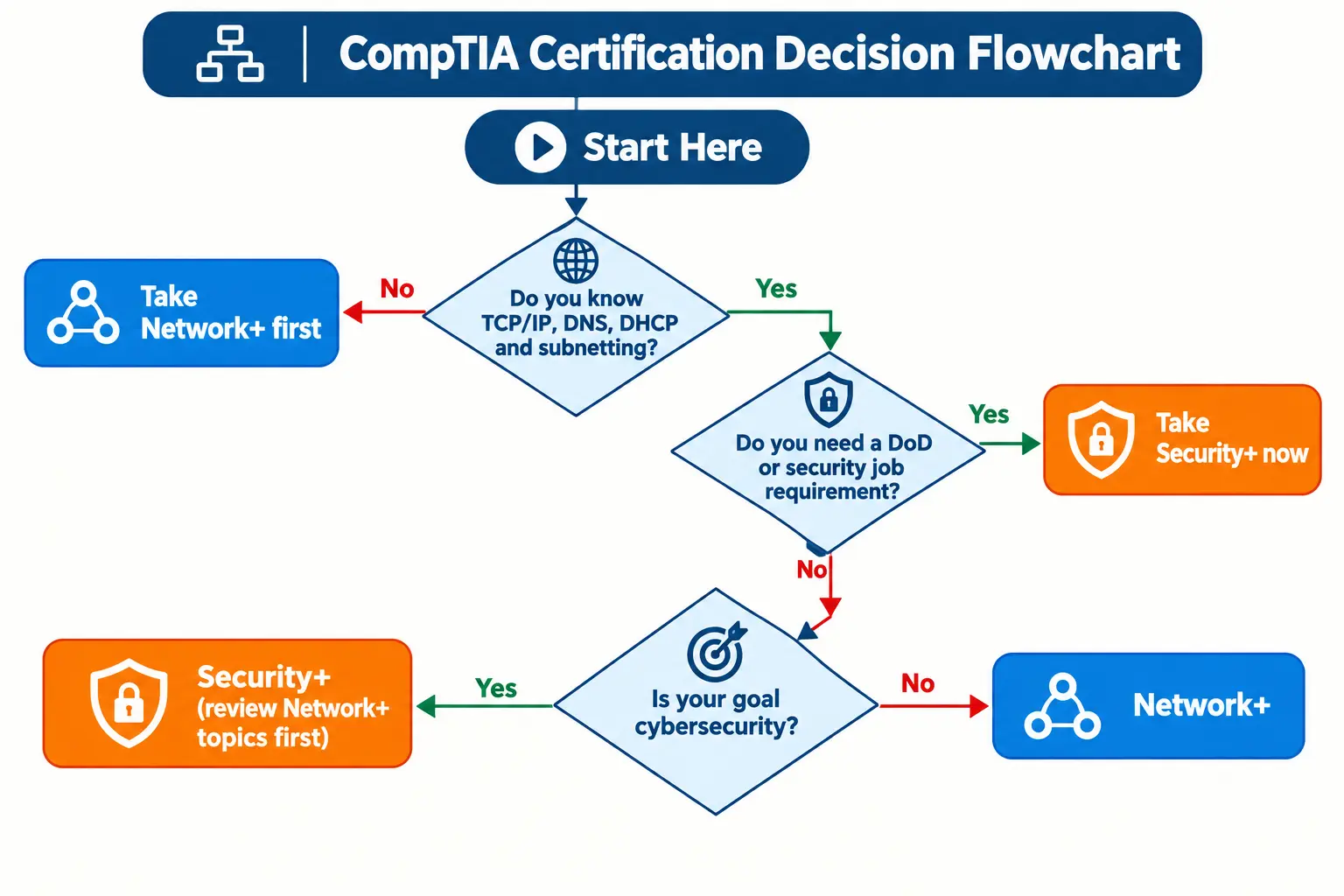
- Complete beginner: Start with A+ or Network+. You’ll learn how devices and networks work before you try to protect them.
- Help desk with 1 to 2 years: Network+ first. It fills gaps and helps you read network traffic later.
- Sysadmin or network engineer: Go straight to Security+. You already have the base.
- Career changer with no IT background: Network+ (or A+ then Network+). Plan on more study time.
- Aiming for a defense or government role: Security+ is often listed in job posts. Read the exact requirements for your role.
An easy test: if you can explain TCP/IP, DNS, DHCP and common ports in your own words, start with Security+. If not, start with Network+.
Is Security+ or Network+ Worth It in 2026?
Yes, for most beginners, but with realistic expectations.
- Worth it if you’re breaking into IT and want a clear starting goal, or your employer asks for the cert.
- Less useful if you already have strong experience and a good job record. Experience often matters more than another cert.
The IT job market is competitive right now, and entry-level roles get many applicants. A cert helps you stand out, but projects, support experience and good communication help even more. If you’re short on money, pick one cert that matches the job you actually want and build skills around it.
Study Time and 90-Day Roadmap
These are rough estimates for someone studying 8 to 10 hours a week. Your time may be shorter or longer.
- Network+: about 6 to 10 weeks
- Security+: about 8 to 12 weeks
A simple plan for one cert:
- Days 1 to 30: Watch a full video course and take notes on each exam domain.
- Days 31 to 60: Do labs, practice PBQs and write flashcards for ports and acronyms.
- Days 61 to 90: Take timed practice tests, review wrong answers and book the exam when you score steadily above 80 percent.
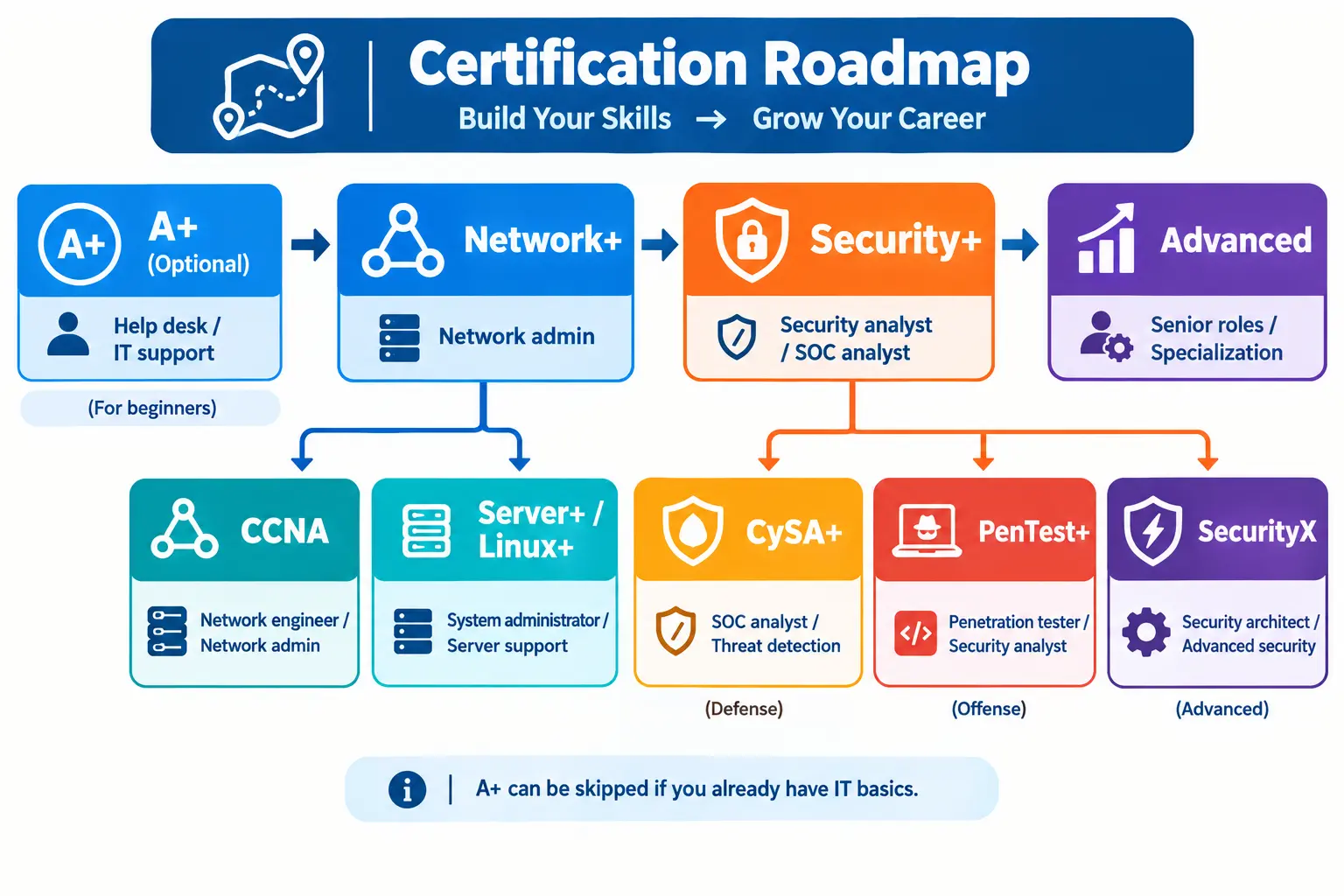
What to Take After: CCNA, CySA+, Linux+, Server+
- After Network+: CCNA (Cisco networking), Server+ or Linux+ if you want sysadmin work.
- After Security+: CySA+ for defense and analysis, PenTest+ for ethical hacking, or SecurityX for advanced security roles.
- Not sure? Look at job posts for the role you want and see which certs they mention most.
Network+ leads to networking tracks. Security+ leads to security tracks. Linux+ and Server+ are useful if you’ll manage servers.
Frequently Asked Questions
Is Network+ worth it before Security+?
It’s worth it if you’re new to networking. You can take Security+ without it, but you’ll need the same knowledge to follow the topics.
What percentage do you need to pass the Network+?
You need a scaled score of 720 out of 900. It isn’t an exact percentage, but aiming for 80 to 85 percent on practice tests is a safe target.
Is Security+ harder than Network+?
For most people, slightly. Security+ is broader and more scenario-based. Network+ is more technical and hands-on.
Can you get a job with only Security+?
Sometimes, but it’s hard without experience. Combine the cert with an IT support job, home labs and projects.
Which pays more, Security+ or Network+?
Security roles usually pay more at the median. BLS shows $124,910 for information security analysts and $96,800 for network and systems administrators. Your pay still depends on experience, location and employer.
Is it worth getting both Network+ and Security+?
Yes, if you want a security career and need the networking base. If you only want network or support work, Network+ may be enough for now.
How long does it take to prepare for Security+ with no IT experience?
Plan for roughly 3 to 6 months if you start from scratch, including basic networking. People with IT experience often need 8 to 12 weeks.
Do CompTIA certifications expire?
Yes. Both are valid for three years. You renew them through CompTIA’s continuing education program or by passing a newer or higher exam.
Conclusion
The best choice depends on where you are today. If networking is new to you, Network+ gives you the base. If you know the basics and want a cybersecurity path, the Security+ certification is a strong next step. Pick one, make a study plan, and book your exam date so you stay on track.