
CCNA vs Network+: Which Certification Should You Choose in 2026?
Picking your first networking certification feels harder than it should be. Two names keep showing up everywhere: Cisco’s CCNA and CompTIA’s Network+. This guide breaks down exactly how they differ, what each one actually costs you in time and money, and which one fits your situation — whether you’re a total beginner, a career-changer, or already a year into IT.
Before You Start
Table of Contents
What Is CCNA?
CCNA (Cisco Certified Network Associate) is Cisco’s entry-level certification. It proves you can actually configure, run, and troubleshoot a network — but only on Cisco equipment. Think of it as learning to drive, except the car is always a Cisco router.
What it covers:
- Network fundamentals (LANs, WANs, VLANs)
- Routing and switching
- IP addressing and subnetting
- Basic network security
- Wireless networking
- Automation and programmability (yes, even scripting)
Best for: People who already know they want to become network engineers or work in a Cisco-heavy environment.
What Is CompTIA Network+?
Network+ is CompTIA’s foundational networking certification. It’s vendor-neutral, meaning it doesn’t care whether your company runs Cisco, Juniper, or Ubiquiti. It teaches you how networks work in general — the concepts every IT professional needs, regardless of brand.
What it covers:
- Networking fundamentals and the OSI/TCP-IP models
- Network protocols and ports
- Basic security and troubleshooting
- Cloud and virtualization basics
- Day-to-day network operations
Best for: Beginners, help desk staff, and anyone who wants broad IT knowledge before specializing.
CCNA vs Network+: Quick Comparison
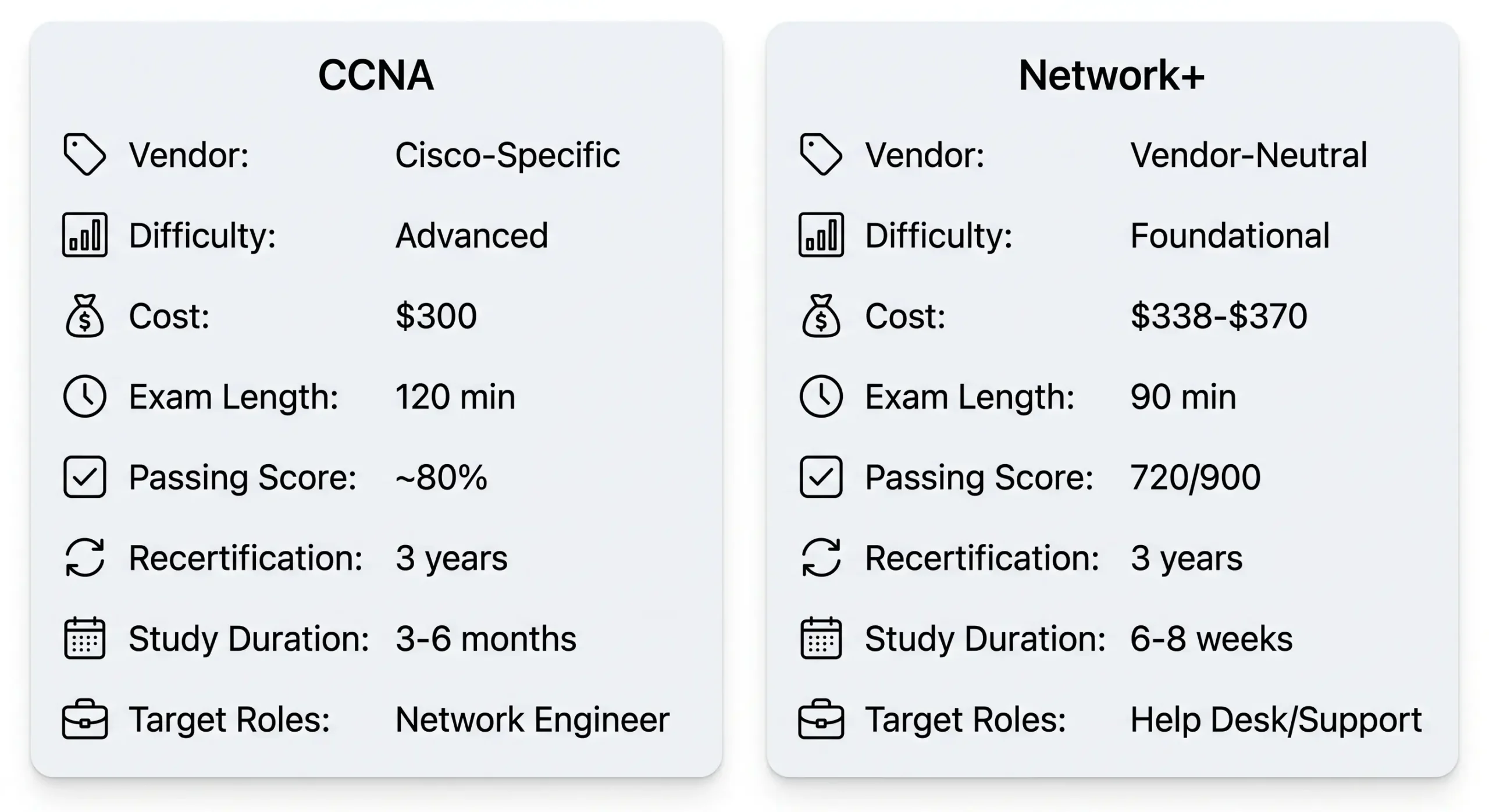
Here’s the side-by-side breakdown, using the current 2026 exam data (Network+ N10-009 and CCNA 200-301):
| Feature | CCNA | Network+ |
| Vendor | Cisco-specific | Vendor-neutral |
| Difficulty | Advanced | Foundational |
| Cost | $300 | $338–$370 |
| Exam length | 120 minutes | 90 minutes |
| Passing score | ~80% | 720/900 |
| Recertification | Every 3 years | Every 3 years |
| Study duration | 3–6 months | 6–8 weeks |
| Target roles | Network Engineer | Help Desk / Support |
A quick note on cost: CCNA looks cheaper upfront, but most people end up spending more overall on labs, practice exams, and Cisco Packet Tracer training to actually pass the simulation questions.
Key Differences Explained
When people ask about CCNA vs Network+, this is usually the part that actually decides their choice.
Vendor-Neutral vs Vendor-Specific
Network+ teaches you networking the way a textbook would — concepts that apply everywhere. CCNA teaches you networking the way a job would — hands-on, but tied to one company’s tools. If your company ever switches away from Cisco, your Network+ knowledge stays useful. Your CCNA skills mostly transfer, but the exact commands don’t.
Exam Format: Multiple Choice vs Simulations
This is the biggest practical difference people don’t expect:
- Network+ relies on multiple-choice and drag-and-drop questions. You can often guess your way to a partial answer.
- CCNA drops you into a real command-line simulation. You have to type actual Cisco IOS commands to configure a router or fix a broken VLAN. There’s no guessing — either you know the command or you don’t.
Career Path Focus
Network+ opens doors to general IT roles. CCNA opens doors to networking-specific, higher-responsibility roles. Neither is “better” — they’re built for different stages of a career.
Network+ Exam Format & Preparation
Network+ Exam Format (N10-009) Explained
The current version of the exam, N10-009, runs 90 minutes with a maximum of 90 questions. You’ll see:
- Multiple-choice questions
- Drag-and-drop matching
- A handful of performance-based questions (basic diagrams, simple config tasks)
You need a minimum score of 720 out of 900 to pass. Compared to CCNA, the pressure is lower — there’s more room to work through a question using elimination.
Best Study Guides & Courses for Network+
You don’t have to spend a fortune to prepare for it. A solid Network+ study plan usually includes:
- One structured course (video-based, self-paced) to cover the objectives in order
- One official study guide or book for reference and deeper reading
- Practice exams to get used to the question style before test day
Books vs. Course — Which Is Enough?
Honestly, a good course alone is usually enough for most people. Books work better as a backup reference when a concept doesn’t click from video alone — think of it like watching a recipe video vs. keeping the actual recipe card nearby. If you’re short on time, skip buying both and focus your budget on quality practice exams instead — that’s what actually predicts your pass/fail outcome.
How Long Does Each Certification Take?
- Network+: 6–8 weeks, studying about 10 hours a week
- CCNA: 3–6 months, studying 10–15 hours a week, including lab time
The extra months for CCNA aren’t just “more content” — it’s the hands-on lab practice (Packet Tracer or GNS3) that eats up time. You can’t skip this part; the exam is designed so you literally cannot pass by memorizing definitions.

CCNA or Network+ for a Beginner?
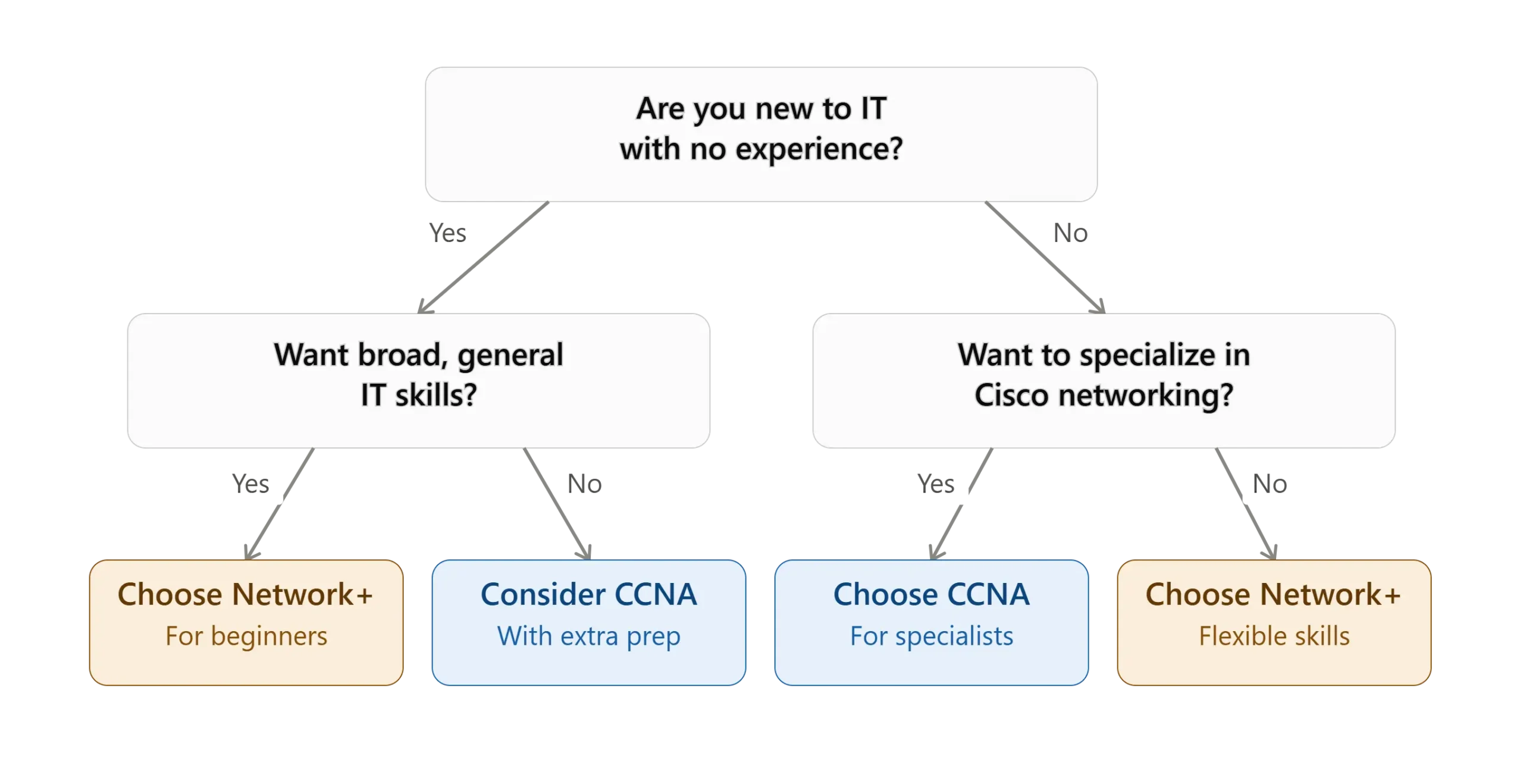
The CCNA vs Network+ decision gets a lot easier once you break it into three simple questions.
- Are you completely new to IT, with zero hands-on experience?
If yes, keep going. If no, skip to question 3. - Do you want broad, general IT skills rather than one specific path?
If yes → Network+ is your answer.
If no (you already know you want networking specifically) → CCNA is worth considering, but expect a steeper learning curve without a support base of experience yet. - Do you specifically want to specialize in Cisco networking or infrastructure?
If yes → CCNA.
If no → Network+ still makes more sense for flexibility.
A simple way to think about it: Network+ is like learning to cook in general. CCNA is like training specifically to become a sushi chef. Both are valuable — one just commits you to a narrower kitchen.
Should You Do Both? Which One First?
This is where most CCNA vs Network+ debates online miss the point — it’s rarely an either/or choice.
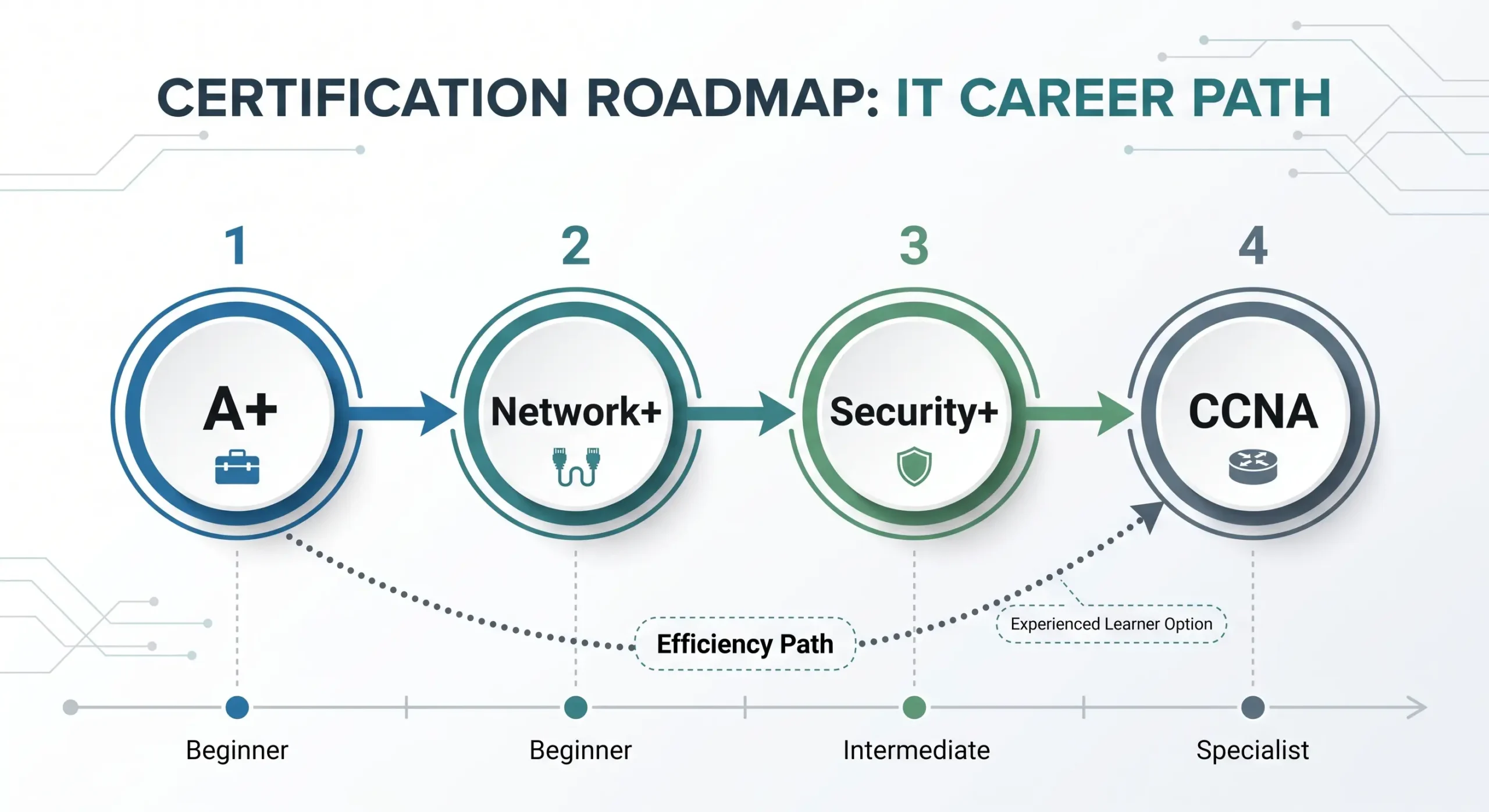
The stackable path (recommended for true beginners):
- CompTIA A+ → basic hardware/software troubleshooting
- Network+ → how devices connect and communicate
- Security+ → how to protect those connections
- CCNA → specialize in Cisco infrastructure
This path takes longer, but each step builds real experience you can put on a resume before tackling the next one.
The efficiency path (for people with 1+ year of IT experience):
Skip straight to CCNA. You already have the foundational knowledge Network+ would teach you, so there’s no point repeating it. Going back for Network+ after already earning CCNA offers zero professional benefit — hiring managers assume you already know the basics.
Is Network+ Necessary Before A+?
No — and it works better the other way around. CompTIA A+ covers hardware, operating systems, and basic troubleshooting, which is the layer below networking concepts. Most people who skip A+ and jump straight to Network+ find themselves confused by hardware-related questions they were never taught. If you have zero IT background, start with A+, then move to Network+.
Career Opportunities After Each Certification
After Network+:
- IT Support Specialist
- Network Technician
- Help Desk Engineer
- Junior Systems Administrator
After CCNA:
- Network Engineer
- Network Administrator
- Systems Engineer
- Infrastructure Engineer
Network+ gets your foot in the door. CCNA moves you into roles where you’re actually designing and maintaining the network, not just supporting the people using it.
Salary & Job Market Outlook in 2026
Salary is where the CCNA vs Network+ comparison stops being theoretical and starts affecting your paycheck.
- Network Support Specialist: $53K–$61K
- Network Administrator: $64K–$66K
- Security Engineer (CCNA path): $84K
- Network Security Analyst (CCNA path): $124K
- Computer & Information Systems Manager (CCNA path): $171K

Beyond salary, the job market itself is growing. Information security roles — many of which favor CCNA holders — are projected to grow around 29% through 2034, making it one of the fastest-growing fields in tech right now.
A quick reality check: a certification gets your resume past the automated filters recruiters use (called an ATS). It does not guarantee the job. You still have to prove your skills in the interview.
Other Certifications Worth Considering
If you’re mapping out your next few years, keep these on your radar too:
- CompTIA Security+ — the natural next step after Network+, focused entirely on cybersecurity fundamentals
- CCNP (Cisco Certified Network Professional) — the advanced version of CCNA, for once you’re ready to go deeper into Cisco infrastructure
- CompTIA A+ — if you haven’t already, this is genuinely the best starting point for anyone with zero IT background
None of these replace CCNA or Network+ — they build on top of whichever one you choose first.
Frequently Asked Questions
CCNA vs Network+ — which one should I choose first?
If you’re a complete beginner, start with Network+. It’s cheaper, faster to prepare for, and builds the foundation CCNA later assumes you already have. If you already have a year or more of IT experience, you can go straight to CCNA.
Is CCNA more difficult than Network+?
Yes, noticeably. Network+ relies mostly on multiple-choice questions, while CCNA includes hands-on command-line simulations where you must configure real network scenarios correctly — there’s no room to guess.
How hard is the CompTIA Network+ (N10-009) exam?
It’s considered beginner-friendly compared to CCNA. Most people with 6–8 weeks of consistent study and a decent course can pass it, even with little prior networking experience.
Should I buy books for Network+, or is a course enough?
A good course is usually enough on its own for most learners. Books help as backup reading if a specific topic doesn’t click through video, but they’re not essential if your course already covers the full exam objectives.
Can I take Network+ before A+?
You can, but it’s not ideal. A+ covers hardware and OS basics that Network+ assumes you already understand. If you’re starting from zero, do A+ first.
What’s the best networking certification for a beginner or a computer science graduate?
For someone with no hands-on experience, Network+ is the safer starting point regardless of degree. A computer science background helps with the concepts, but it doesn’t replace the practical networking knowledge Network+ teaches.
Why do people say Network+ is hard?
It’s rarely the difficulty of the concepts — it’s the sheer amount of new terminology and protocols packed into one exam. Consistent study over several weeks makes it manageable.
What certifications should I get after 1 year in an IT role?
At that point, most people are ready to skip Network+ and go directly for CCNA, especially if their company uses Cisco infrastructure. If security interests you more, Security+ is a strong alternative next step.
Final Verdict
If you remember nothing else from this CCNA vs Network+ breakdown, remember this. There’s no universally “better” certification here — only a better fit for where you are right now.
- Choose Network+ if you’re new to IT, want flexible and vendor-neutral skills, or you’re heading toward general support roles.
- Choose CCNA if you already have some experience and you’re committed to networking as a specialty, especially in Cisco-based environments.
Whichever you pick, treat it as a starting point, not a finish line. The professionals earning six figures in this field usually hold both certifications — they just didn’t try to get them at the same time.