
CCNP Enterprise: The Next Step After CCNA
(Complete CCNP Study Guide 2026)
Passed CCNA and wondering what to do next? This CCNP study guide covers the exams, cost, study plan and resources, so you can decide if CCNP Enterprise fits your career.
Before You Start
Table of Contents
What Is CCNP Enterprise and What Changed in 2026
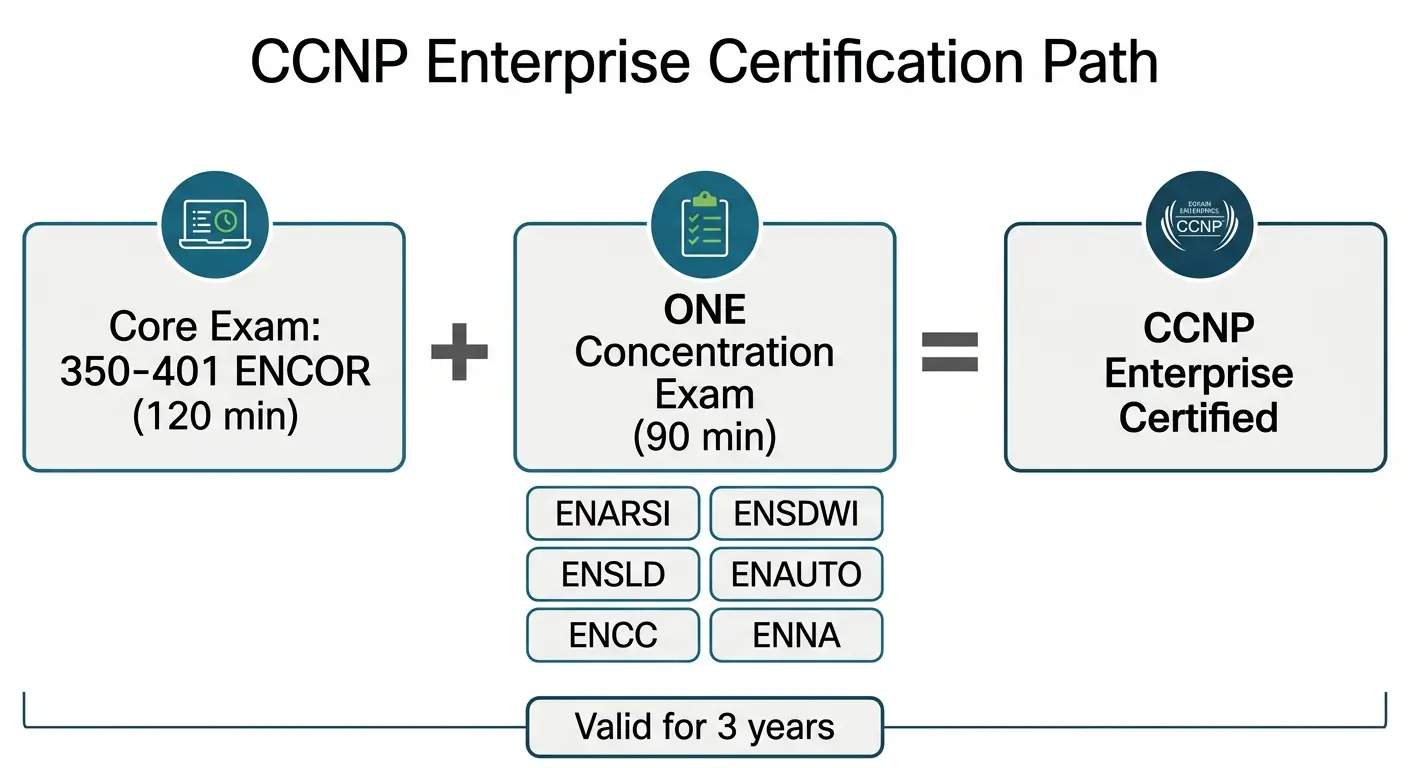
CCNP Enterprise is Cisco’s professional-level certification for people who design, build and manage enterprise networks. You earn it by passing two exams: one core exam and one concentration exam of your choice. The certification is valid for three years.
Think of it like a university degree. The core exam is your main subject. The concentration exam is your specialization.
Cisco changed its program in February 2020:
- Old CCNP tracks with 3-4 exams were replaced by the “core + concentration” model.
- Old CCNP Routing and Switching and CCNP Wireless holders moved to CCNP Enterprise.
- CCNA is no longer required to start.
Cisco has also updated the concentration list since then. We cover the current list below.
CCNA vs CCNP: Key Differences and Difficulty
CCNA teaches you how networks work. CCNP teaches you how to build, fix and improve large networks.
| Feature | CCNA | CCNP Enterprise |
|---|---|---|
| Level | Associate | Professional |
| Exams | 1 | 2 (core + concentration) |
| Focus | Basics: IP, VLANs, routing, simple security | Advanced routing, design, automation, assurance |
| Difficulty | Moderate | High |
| Typical roles | Help desk, junior network admin | Network engineer, senior engineer |
| Hands-on skill needed | Basic configuration | Troubleshooting and design decisions |

How Much Harder Is CCNP Than CCNA?
CCNP is noticeably harder. CCNA asks “what is OSPF?” CCNP asks “why is this OSPF neighbor stuck, and how do you fix it?” Expect more depth, more topics and more lab work.
Real-life example: CCNA is like learning the parts of a car and how to drive. CCNP is like learning to repair the engine and plan a route for a whole delivery fleet.
CCNP Prerequisites: Can You Skip CCNA?
There is no official prerequisite for CCNP. Cisco does not require CCNA or any other certification to take the exams. You only need to meet the exam registration rules.
Skipping CCNA can work if:
- You already work with routers and switches daily.
- You are comfortable with subnetting, VLANs and basic routing.
- You can read configs and troubleshoot without much help.
Take CCNA first if:
- You are new to networking.
- Subnetting still feels confusing.
- You have never configured a Cisco device.
Real-life example: Rizwan has worked as a network technician for four years. He can configure OSPF and troubleshoot VLAN issues. He can go straight to CCNP. Ayesha just finished her computer science degree and has never touched a router. She will struggle with CCNP and should start with CCNA.
A quick test: if you can subnet a network in your head and explain how a packet travels from your laptop to a website, you are likely ready.
CCNP Enterprise Exams: Core and Concentration
You need one core exam and one concentration exam.
Core exam: 350-401 ENCOR (Implementing Cisco Enterprise Network Core Technologies). It is a 120-minute exam.
Concentration exams (choose one, 90 minutes each):
| Exam | Code | Focus |
|---|---|---|
| ENARSI | 300-410 | Advanced routing, VPN, infrastructure services |
| ENSDWI | 300-415 | Cisco Catalyst SD-WAN |
| ENSLD | 300-420 | Enterprise network design |
| ENAUTO | 300-435 | Network automation and programming |
| ENCC | 300-440 | Cloud connectivity |
| ENNA | 300-445 | Network assurance and monitoring |
Older exams like ENWLSD and ENWLSI (wireless) are not on Cisco’s current CCNP Enterprise page. Always check cisco.com before you book.
Exam Format and Taking the Exam Online
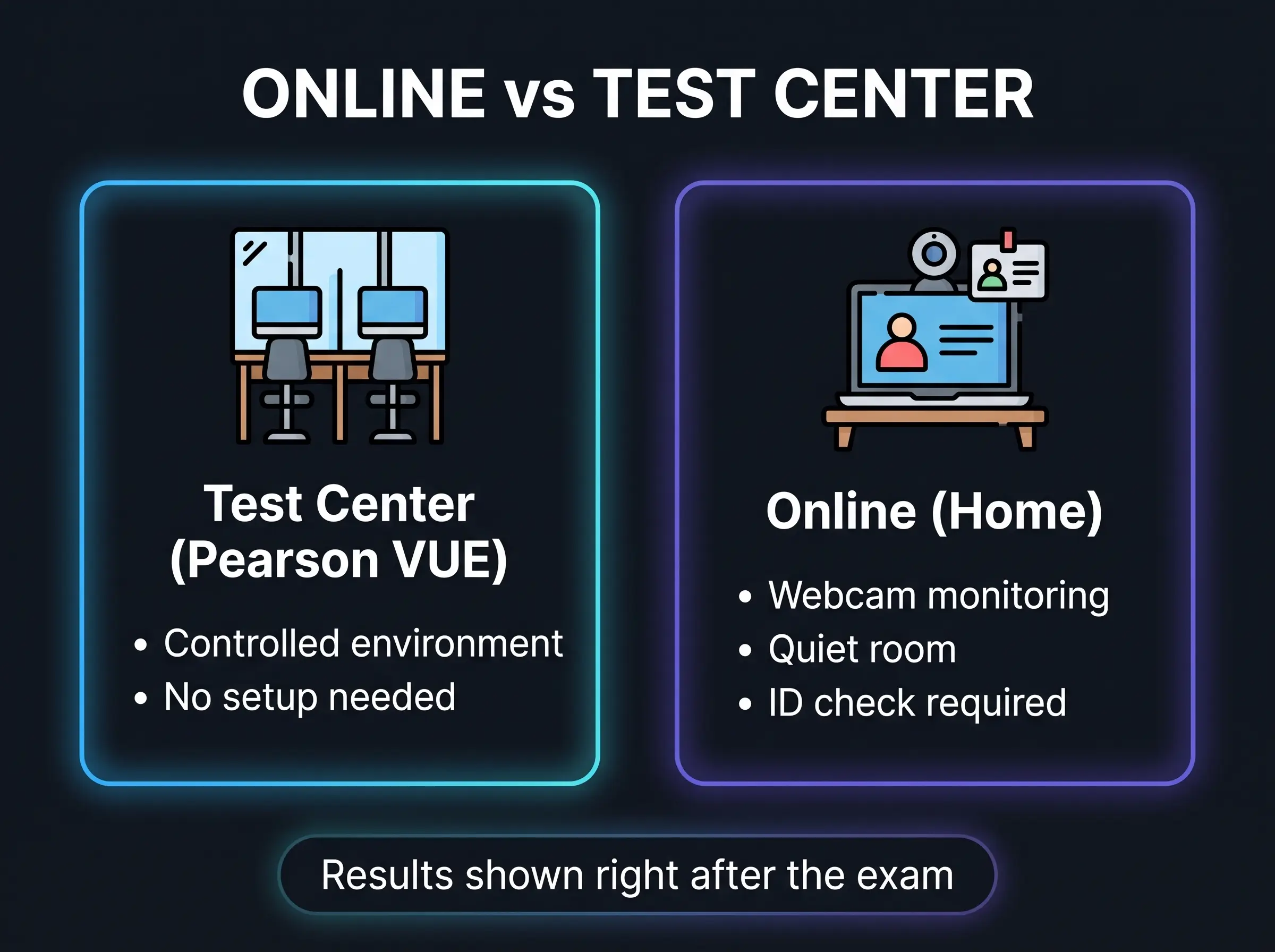
Exams are booked through Pearson VUE. You can test at a center or from home with a webcam.
- Question types: multiple choice, drag-and-drop, fill-in-the-blank, testlets, simulations and simlets.
- Passing score: Cisco does not publish it. It is commonly reported around 800-850 out of 1000.
- Results: shown right after the exam, with only basic score details.
- Home exam: needs a quiet room, a clean desk, ID and a stable internet connection.
CCNP ENCOR Exam Topics Breakdown
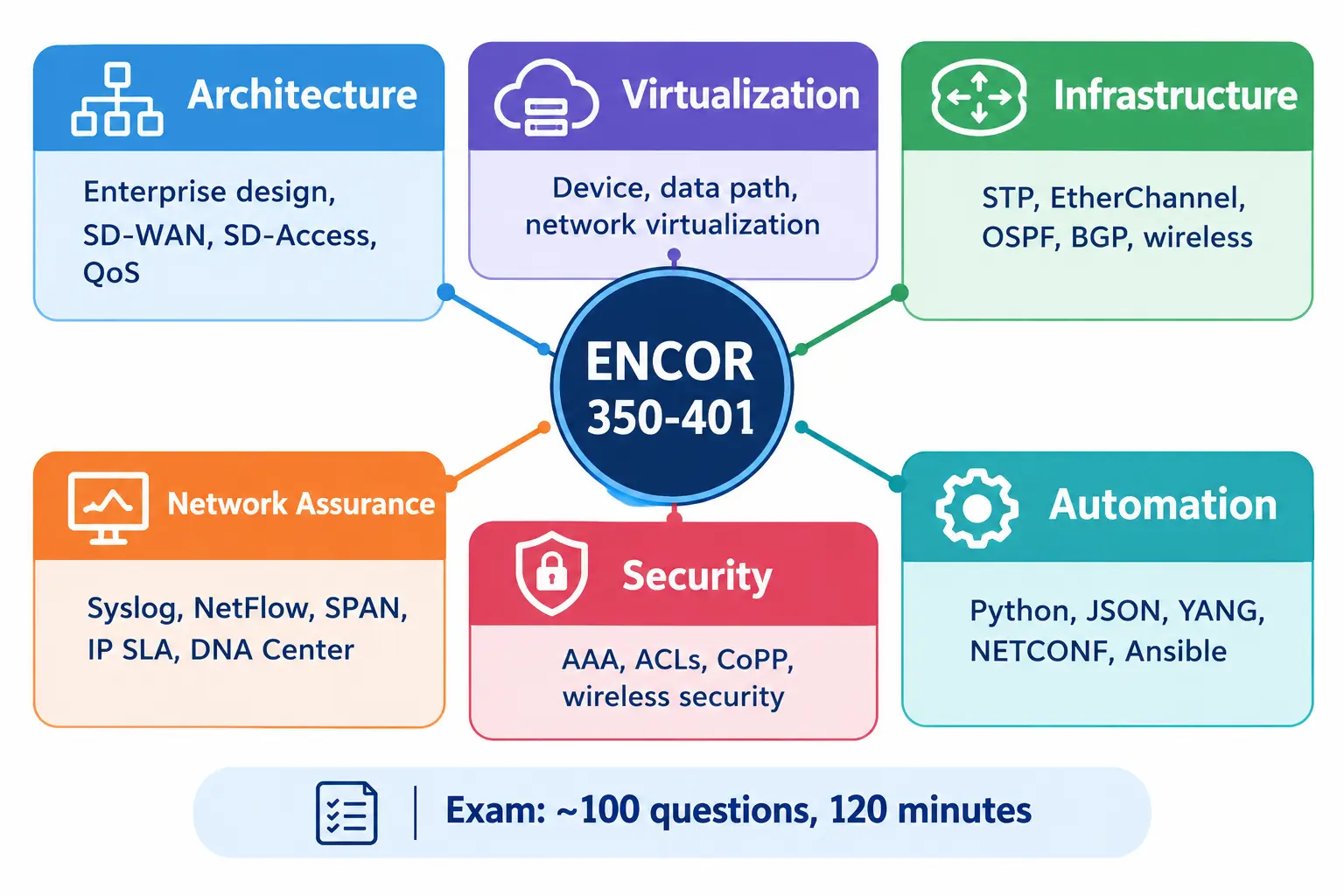
ENCOR covers six areas. Here is what each one means in simple words:
- Architecture: enterprise network design, wireless design, SD-WAN, SD-Access and QoS.
- Virtualization: running virtual devices and networks, like splitting one physical switch into many logical ones.
- Infrastructure: the core protocols. STP, EtherChannel, OSPF, EIGRP, BGP, wireless and IP services like NAT and DHCP.
- Network Assurance: finding problems. Syslog, NetFlow, SPAN, IP SLA and Cisco Catalyst Center.
- Security: AAA, ACLs, device hardening and wireless security.
- Automation: Python basics, JSON, YANG, APIs, NETCONF/RESTCONF and tools like Ansible.
Topics Candidates Underestimate
Based on common community feedback (Reddit and forums):
- BGP and OSPF details: many people know the basics but not path selection or troubleshooting.
- Automation: network engineers often skip Python and APIs, then lose easy marks.
- QoS and wireless: these look small but appear regularly.
- Time pressure: some candidates run short on time because of lab-style questions.
Treat the official exam blueprint on cisco.com as your checklist. Topics can change.
Which CCNP Concentration Exam Should You Choose?
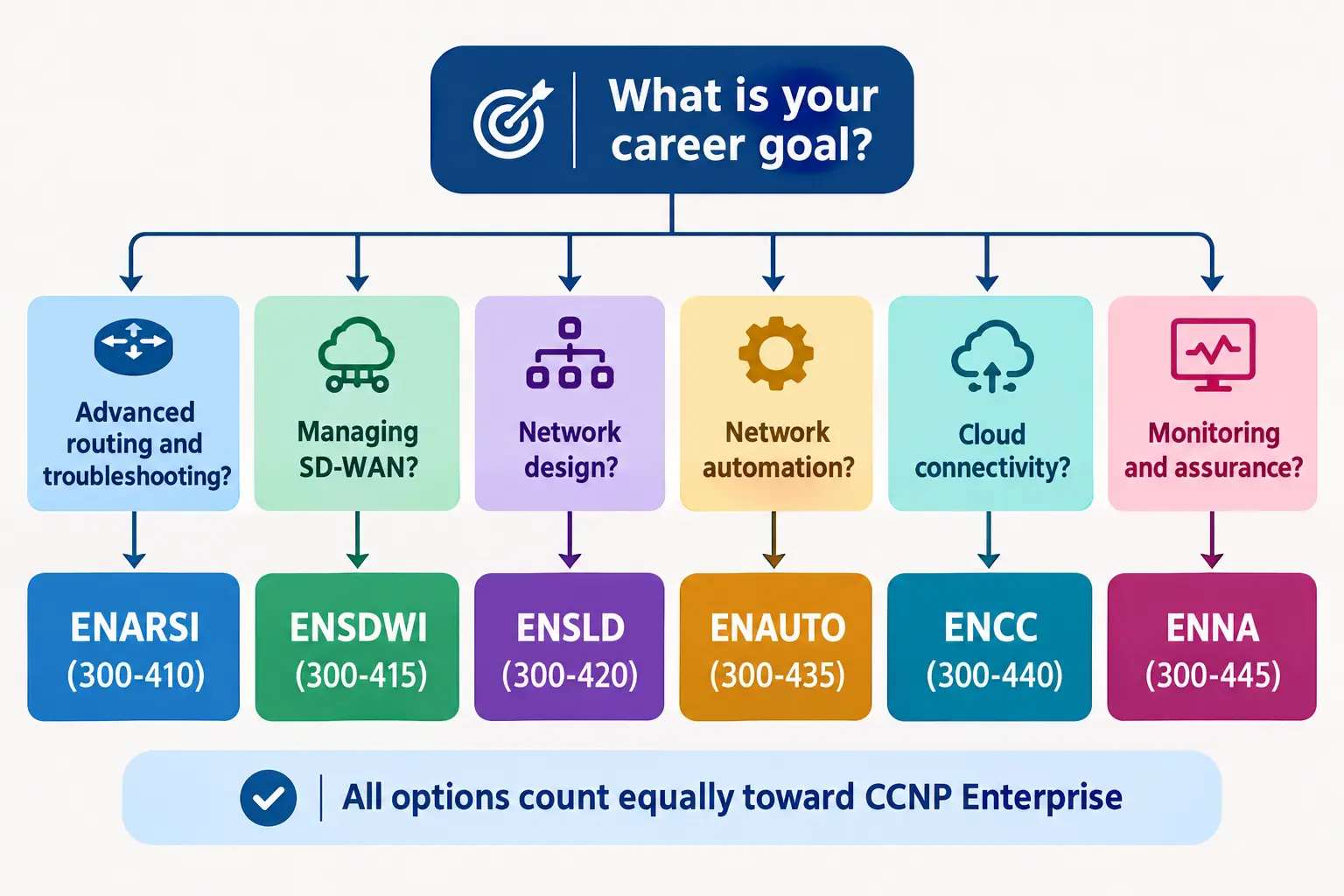
Choose the exam that matches the work you do or want to do. All options count equally toward CCNP Enterprise.
| If you want to… | Choose |
|---|---|
| Work with complex routing and troubleshooting | ENARSI |
| Manage branch networks with SD-WAN | ENSDWI |
| Plan and design networks | ENSLD |
| Automate network tasks with code | ENAUTO |
| Connect offices to cloud platforms | ENCC |
| Monitor and improve network performance | ENNA |
Easiest for most beginners: ENARSI, because it builds on ENCOR routing topics, and there are plenty of study materials for it. Hardest for non-coders: ENAUTO, because it needs programming comfort.
Real-life example: If you work at an ISP fixing routing problems all day, ENARSI is a natural fit. If your company is moving to cloud services, ENCC makes more sense.
CCNP Certification Cost and Retake Policy
The exam fees alone are about $700 (approx.): around $400 for ENCOR and $300 for one concentration exam. Prices vary by country and can change, so confirm on cisco.com.
Your real cost also includes study materials, lab tools and practice tests:
| Plan | Study material | Lab | Practice tests | Total cost |
|---|---|---|---|---|
| Budget | Free resources + 1 book | Free tools | Free | Low |
| Mid-range | Video course + book | Cisco CML personal | 1 paid set | Medium |
| Premium | Official Cisco course | CML + extra labs | Multiple paid sets | High |
Tip: Exam fees are the same for everyone. The difference comes from your study choices. A budget plan with strong discipline can work as well as a premium one.

What Happens If You Fail?
You can retake the exam, but you pay the full fee again. Cisco usually sets a short waiting period between attempts (commonly 5 days). Check the current retake policy on cisco.com. After a fail, study your weak topics before rebooking.
CCNP Study Guide: 12-16 Week Study Plan
This plan suits someone studying 8-10 hours a week for ENCOR. Concentration exams need extra time afterward.
| Weeks | Focus | What to do |
|---|---|---|
| 1-2 | Setup | Build your lab, review CCNA gaps |
| 3-6 | Infrastructure | STP, EtherChannel, OSPF, BGP labs |
| 7-9 | Architecture and Virtualization | SD-WAN, SD-Access, QoS, wireless |
| 10-12 | Assurance, Security, Automation | NetFlow, ACLs, Python, NETCONF |
| 13-16 | Practice | Practice exams, weak topics, book the exam |
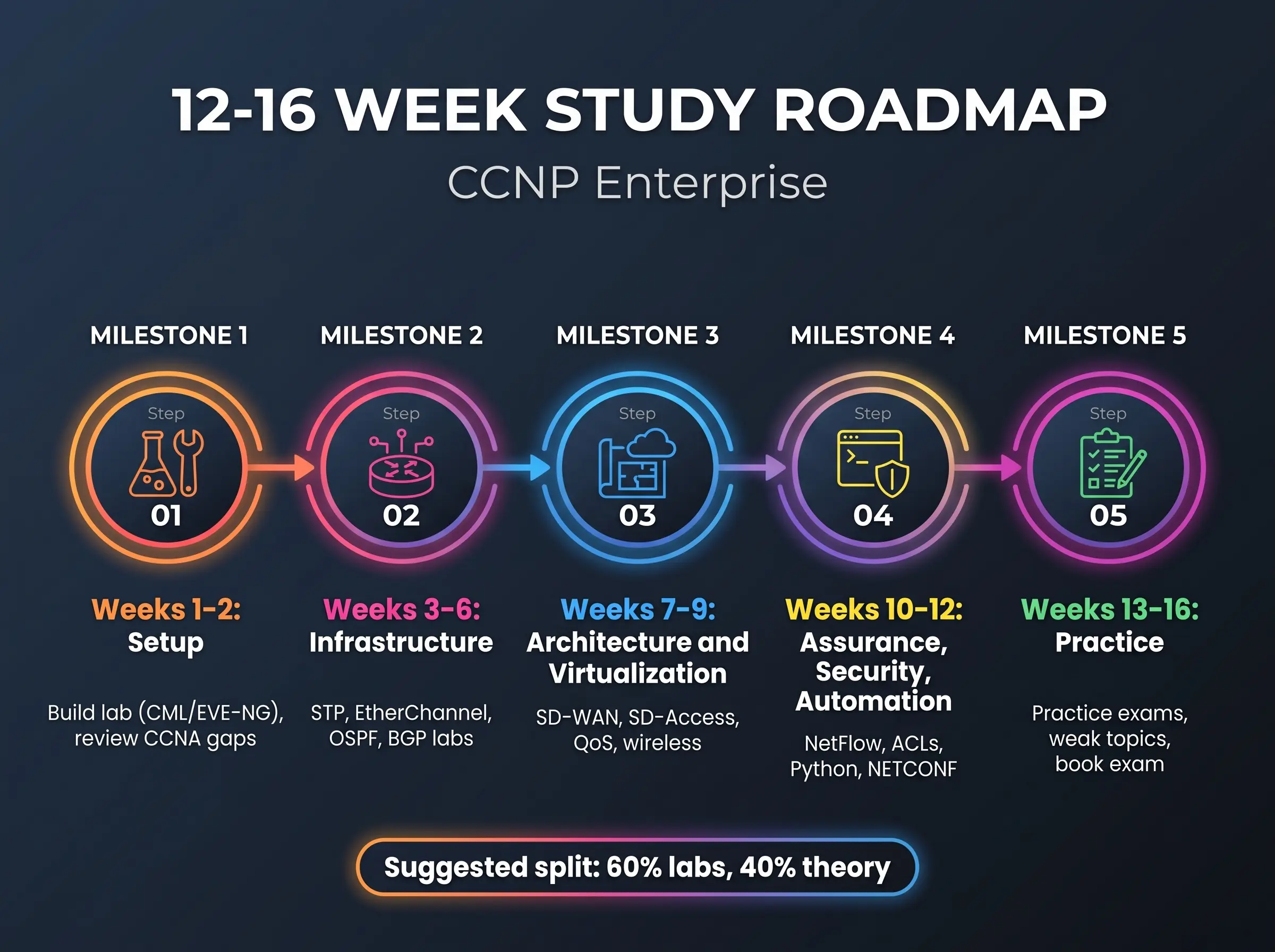
Suggested split: 60% labs, 40% theory. Reading alone does not work for CCNP.
If you have a full-time job:
- Study 1-2 hours on weekdays and longer on weekends.
- Use lunch breaks for videos or flashcards.
- Stretch the plan to 16-20 weeks. Steady progress beats burnout.
Real-life example: Imran works 9 to 5. He studies one hour each morning and does a long lab on Sunday. In four months he finishes the whole syllabus without skipping his weekends.
CCNP Course and Best Study Resources
Every good CCNP study guide starts with the right tools, and Cisco’s official ENCOR course is optional. Many people pass with books, videos and labs.
| Type | Free options | Paid options |
|---|---|---|
| Learning | Cisco documentation, YouTube, Cisco U. free content | Video courses, official Cisco books |
| Labs | Packet Tracer (limited), GNS3 | Cisco CML, EVE-NG Pro |
| Practice | Community quizzes | Paid practice exam platforms |
Can you pass with only free resources? Yes, it is possible, but it takes more time and discipline. You must build labs yourself and double-check the quality of what you use.
Lab Tools: CML, EVE-NG, GNS3 and Packet Tracer Limits
- Cisco CML: official, reliable and affordable. Best choice if you can pay.
- EVE-NG: flexible and popular, but you need to bring your own images.
- GNS3: free and good for routing labs. It needs setup effort.
- Packet Tracer: great for CCNA, but too limited for many CCNP topics like advanced BGP, SD-WAN or automation.
CCNP Practice Questions and Practice Exams
Practice tests are the best way to check your progress while following any CCNP study guide. Start questions after you finish each topic, then take full practice exams in the last 3-4 weeks.
How to use them well:
- Review every wrong answer and write down why you missed it.
- Redo labs for weak topics.
- Time yourself like the real exam.
Avoid brain-dump sites. They sell leaked real exam questions. This breaks Cisco’s rules and can get you banned. It also hurts your skills, because memorized answers do not help at work.
Real-life example: A learner scores 60% on a practice test, then finds she missed all the BGP questions. She spends a week on BGP labs and scores 85% next time. Practice tests are for finding gaps, not for memorizing.
CCNP Automation: Is It Worth Learning?
Yes. Automation is now part of ENCOR itself, and ENAUTO is a full concentration option. Cisco also links ENAUTO to its newer automation certification path.
Why it matters:
- Companies want faster, error-free changes across hundreds of devices.
- Basic Python and APIs save hours of manual work.
Real-life example: Changing a VLAN on 200 switches by hand takes days. A short Python script can do it in minutes.
You do not need to be a software developer. Start with simple scripts and JSON.
Exam Day Tips
Your CCNP study guide is only useful if you stay calm on exam day, so keep these tips in mind.
- Check your ID, booking time and test rules the day before.
- For home exams, clean your desk and test your webcam and internet early.
- Do not spend too long on one question. Mark it and move on.
- Practice simulations and drag-and-drop questions ahead of time.
- Read each question twice. Small words like “not” change the answer.
- Sleep well. Do not study new topics the night before.
After CCNP: Career, Salary and Recertification
Is CCNP worth it in 2026? For most network engineers, yes. It proves hands-on skill at a professional level and can help with promotions and better roles. It is less useful if you want to move fully into another field, like pure cloud development.
Common roles after CCNP:
- Network engineer
- Senior network or infrastructure engineer
- Network automation engineer
- Network consultant
Salary depends heavily on your country, experience and employer, so check local job listings for real figures. Certification helps, but experience still matters most.
Recertification: CCNP is valid for three years. You can renew by passing another eligible exam, earning Continuing Education credits, or moving up to a higher certification. Check Cisco’s current rules for exact options.
Next step: CCNP ENCOR is also the core exam for CCIE Enterprise, so passing it opens the door to the expert level.
CCNP FAQ
Can I take CCNP without CCNA?
Yes. Cisco has no prerequisite for CCNP. CCNA is optional, but it helps if you are new to networking.
How many exams are required for CCNP?
Two. You need one core exam (ENCOR) and one concentration exam of your choice.
Which exam comes after ENCOR?
You choose one concentration exam: ENARSI, ENSDWI, ENSLD, ENAUTO, ENCC or ENNA. Pick based on your career goal.
What is the total cost of CCNP?
Exam fees are about $700 (approx.) for both exams. Study materials, labs and practice tests add more depending on your plan.
How long does it take to get CCNP?
Most people need 3-6 months for ENCOR and another 2-3 months for the concentration exam, depending on study time and experience.
Can I take the CCNP exam from home?
Yes. Pearson VUE offers online proctored exams. You need a webcam, ID, a quiet room and a stable connection.
Is CCNP worth it in 2026?
For most network professionals, yes. It builds advanced skills and supports career growth. See the career section (“After CCNP”) for details.
Conclusion
CCNP Enterprise is a strong next step after CCNA, and you do not have to wait or follow a fixed path. Use this CCNP study guide as your checklist: pick your concentration, build a lab and follow a steady plan. Your first action today: open the ENCOR exam page on cisco.com and download the official topic list.